
The global cricket ecosystem is facing a phase of serious uncertainty, with nearly ₹4,500 crore worth of financial interests at stake. At the heart of this growing concern is Pakistan’s recent approach toward participation and scheduling in international cricket—an approach that has sparked intense debate among cricket boards, broadcasters, sponsors, and fans across the world.
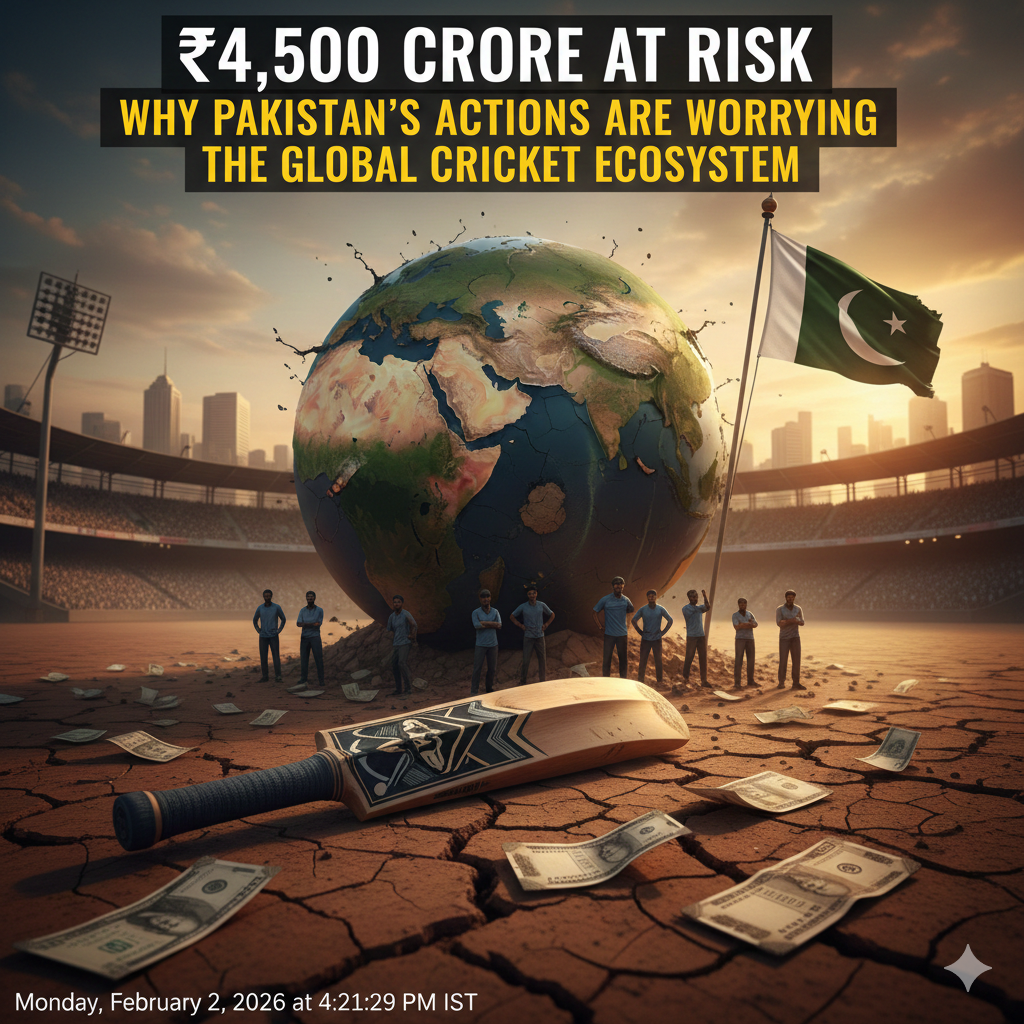
Cricket today is no longer just a sport. It has evolved into a massive global business. From broadcasting rights and sponsorship deals to ticket sales and digital streaming revenue, the sport’s economy depends heavily on stability, predictability, and cooperation among cricket-playing nations. Any disruption—especially involving a major cricketing nation—has the potential to send shockwaves across the entire system.
Pakistan’s Conditional Stance on Participation
The issue arises from Pakistan’s reluctance and conditional attitude toward participating in certain international tournaments, particularly those involving travel or hosting arrangements outside its preferred framework. While such decisions are often explained using political, security, or administrative reasons, their impact goes far beyond bilateral relations.
Major cricket tournaments—especially ICC events and high-profile series—are planned years in advance. Broadcasters invest billions, sponsors commit to long-term global campaigns, and host nations prepare infrastructure and logistics well ahead of time. When uncertainty emerges around the participation of a key team like Pakistan, the entire financial structure begins to shake.
The Financial Weight of Big Matches
According to industry estimates, the combined value of broadcasting rights, sponsorship revenue, advertising income, and match-day earnings linked to affected tournaments could reach ₹4,500 crore. Matches involving Pakistan—especially marquee clashes—attract massive global audiences.
If such fixtures are canceled, postponed, or shifted to neutral venues at short notice, broadcasters risk losing viewership, advertisers face reduced impact, and tournament organizers struggle to justify high investments. The ripple effect doesn’t stop there—it directly affects the ICC’s revenue pool, which supports cricket development worldwide.
Uncertainty Hurts Commercial Confidence
Broadcasters are among the most exposed stakeholders in this situation. Television networks and digital platforms pay enormous sums for exclusive media rights, banking on predictable schedules and high-voltage matches. Any uncertainty forces renegotiations, legal complexities, and potential revenue losses.
Sponsors, meanwhile, are becoming increasingly cautious. Global brands prefer stability when associating with sporting events. A tournament clouded by controversy or last-minute changes becomes a risky marketing investment, pushing sponsors to reconsider their commitment.
Balancing Diplomacy and Stability
The International Cricket Council (ICC) finds itself in a difficult position. It must respect the concerns of its member boards while also protecting the integrity and financial sustainability of global cricket.
If special exceptions become routine, it could set a dangerous precedent. Other nations might adopt similar stances, leading to fragmented tournaments and weakened international cooperation—something cricket can ill afford.
Security, Respect, and Fair Treatment
From Pakistan’s standpoint, concerns over security, fairness, and equal treatment are genuine. The country has invested heavily in rebuilding its reputation as a safe host for international cricket, upgrading stadiums and security infrastructure over the past decade.
However, critics argue that prolonged standoffs and rigid positions could isolate Pakistan further, reducing its influence in global cricket and limiting exposure for its players.
A Crucial Moment for World Cricket
The ongoing situation highlights a deeper structural issue: international cricket lacks a strong conflict-resolution mechanism capable of balancing geopolitical realities with commercial interests. As a result, the sport remains vulnerable to recurring disruptions.

If the current uncertainty continues, the long-term cost may far exceed ₹4,500 crore. Viewer fatigue, sponsor hesitation, and fragmented tournaments could slowly erode cricket’s global appeal.
The Way Forward
Experts believe that dialogue, compromise, and clear long-term policies are the only sustainable solutions. Cricket boards must recognize that short-term positioning can lead to long-term damage if cooperation breaks down. The ICC may also need to adopt firmer guidelines to ensure tournament stability while addressing genuine concerns.
For now, the message is clear: the world is watching, and the future of global cricket’s economic ecosystem hangs in a delicate balance.