[ad_1]
Ever followed a long-haul flight and observed some interesting phenomenon in your observations? The routes taken by the planes tend to deviate far up north, approaching the Arctic. However, planes practically never go south, even near the Antarctica.There is no randomness involved in all of that. The peculiarities are driven by the geography of the region, the economic factors and certain environmental and regulatory issues.Shape of the Earth that decides the flight routesPlanes don’t fly in straight lines according to the map. They use great circle routes – the shortest distance from one point to another on a sphere-shaped Earth.Because of the layout of major cities in the Northern Hemisphere, routes involving these cities frequently tend to be much shorter when passing over the poles. The route from New York to Hong Kong or from London to Tokyo usually crosses either Greenland or North America.Shortening the routes saves money for airline companies. Just saving several hundred kilometres means huge savings, according to route planning guidelines. Polar routes can cut thousands of miles off flight distances.However, in the Southern Hemisphere, it works differently.The placement of cities like Sydney, Johannesburg, and Santiago is done in such a way that flights do not need to fly across Antarctica. Flights generally tend to go via open water paths instead.Flights are determined by demandAnother important factor affecting flight paths is the demand for travel. Most of the busiest flights in the world tend to run between North America, Europe, and Asia, because these continents have the largest number of passengers and shipments.Due to this demand, flights run regularly across the Arctic region, and companies like United Airlines, Lufthansa, and Air Canada use them to connect important cities around the world.In the case of Antarctica, there are no cities, and there is no demand for commercial passenger flights. There are also no airports for regular travellers and no economic reasons for building an entire route network through the continent.There would be no flights if there were no demand, and therefore, airlines would not be willing to risk and pay for flights over a region so far from civilisation.
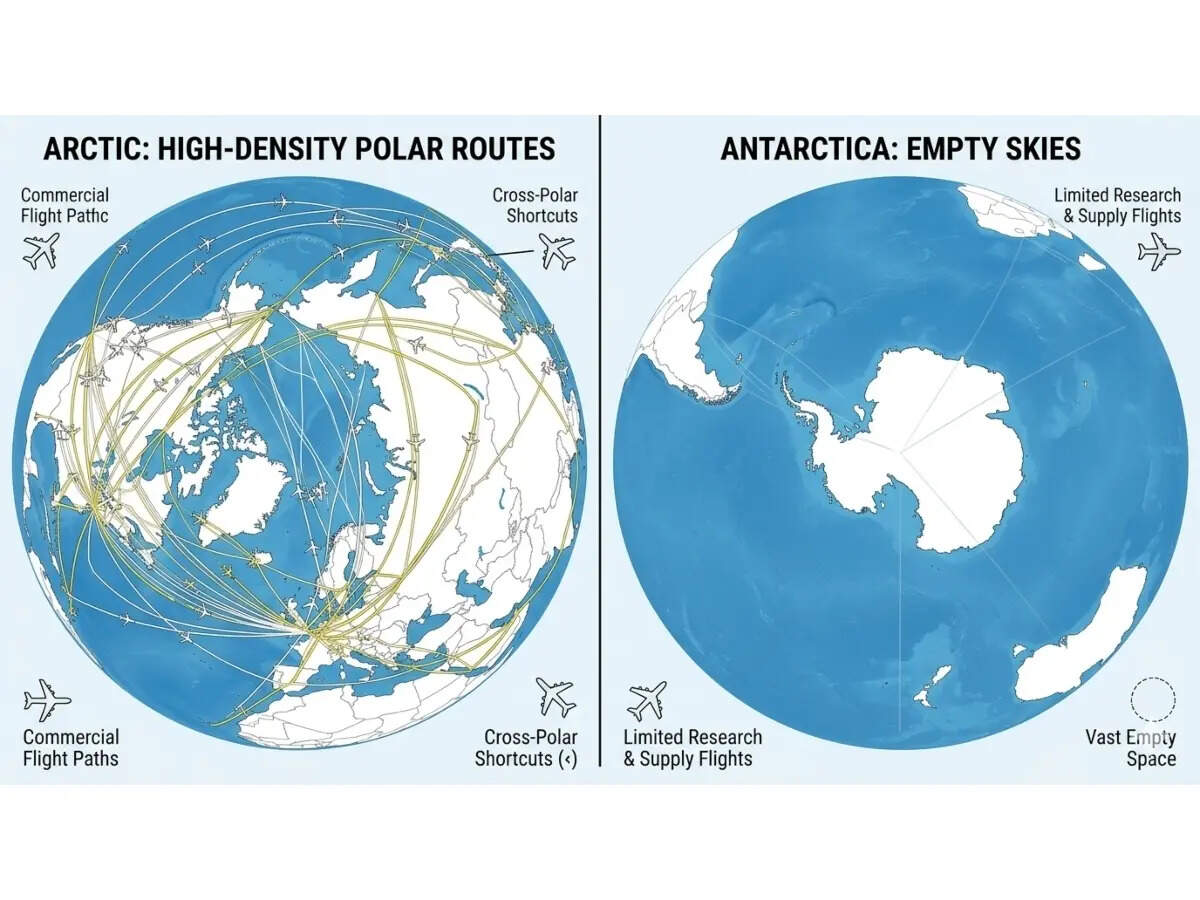
Flights take polar shortcuts in the north but stay away from the south. Image credit – Gemini
Flight paths are governed by safety regulationsAviation today is highly regulated and operates within the confines of strict ETOPS guidelines.These regulations oblige aircraft to stay within a certain flight time of a suitable diversion airport in case of emergencies. Depending on the aircraft type, the duration varies between 180 and 300+ minutes for most long-distance flights.In terms of designated diversion airports, the Arctic features quite a few. Some include Anchorage in Alaska, Keflavik in Iceland, and Iqaluit in Canada.On the contrary, Antarctica lacks any such infrastructure. There are only a few research facilities and airstrips available that cannot be used commercially under certain weather conditions.In other words, from the standpoint of safety, Antarctica appears to be one of the riskiest zones for airliners without any options for landing in an emergency.Extreme weather increases the hazardAs already mentioned, both polar regions are characterised by freezing temperatures. However, Antarctica experiences much more severe weather conditions. It is known to be the coldest and windiest continent on our planet. The temperature could drop below minus 60 degrees Celsius, creating hazardous conditions.Additionally, weather predictions are difficult because of the lack of monitoring stations. This factor adds extra difficulties in planning a route.As for the Arctic zone, it is much easier to manage due to land presence and existing weather reports.Extended darkness is another potential issue with Antarctica. The continent spends almost entirely in the dark during its winter months, and this could cause difficulties for emergency procedures.Historical context led to current routesA history of developments led to today’s aviation network. Throughout the Cold War period, military experts devoted considerable effort to developing navigation capabilities for the Arctic.This effort came from the fact that the shortest route between the United States and the Soviet Union ran through the polar regions.Commercial airliners later used these advances to fly transpolar routes. Airlines started flying such routes in the 1990s using aircraft like the Boeing 747.Antarctica did not develop similarly. There was no reason or need for either military or economic reasons to use the region for commercial flights.Flights come near but do not crossFlights over the Southern Hemisphere can indeed go south enough to pass by Antarctica. Flights from Chile to Australia or New Zealand sometimes pass through Antarctica.Nonetheless, they will not cross Antarctica properly. Specialised flights can be found to Antarctica, but these are mostly scientific or recreational in purpose.One such well-known instance is that of the Air New Zealand Flight 901, which crashed in 1979 while on a sightseeing expedition through Antarctica. This disaster served as evidence of how perilous the area could prove to be.The bottom lineAir travel over the Arctic occurs due to its efficiency, availability of infrastructure, and high level of demand. These three factors are lacking in Antarctica.From regulations to geography and weather, it takes several reasons for planes not to fly over Antarctica.In the present day, there are still very few regions left where commercial airlines do not venture.
[ad_2]
Source link