[ad_1]
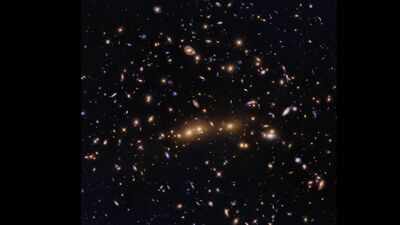
Far beyond the Milky Way, vast collections of galaxies continue to drift, gather and occasionally collide. One such region has drawn astronomers’ attention for decades. Known as CL0016+1609, this immense galaxy cluster contains hundreds of galaxies bound together by gravity and shines strongly in X-ray light. A newly highlighted image from NASA’s Hubble Space Telescope offers another detailed view of this remarkable system, revealing not only the galaxies within the cluster itself but also subtle traces of far more distant objects hidden behind it. According to NASA, the observations are helping scientists investigate a complex cosmic merger while also providing clues about the invisible matter that shapes the structure of the universe.
Two giant galaxy clusters are slowly merging; NASA reveals
At first glance, the Hubble image resembles a crowded patch of sky filled with galaxies of different shapes and sizes. Several large elliptical galaxies dominate the central region, while smaller spiral and lenticular galaxies are scattered throughout the frame.As per NASA, earlier X-ray studies showed that CL0016+1609 is not a single, settled cluster. Instead, it consists of two galaxy clusters moving through a merger along our line of sight from Earth. Such events unfold over immense timescales, stretching across hundreds of millions of years. Although individual galaxies rarely collide directly, the gravitational interaction between the clusters can dramatically reshape the surrounding environment.
How NASA’s Hubble Space Telescope is helping map dark matter
One reason astronomers continue to study CL0016+1609 is its potential to reveal the distribution of dark matter. This mysterious substance cannot be observed directly because it does not emit, absorb or reflect light in ways that telescopes can detect.According to NASA, researchers used Hubble’s Advanced Camera for Surveys to gather observations that could improve measurements of the cluster’s dark-matter structure. While Hubble cannot see dark matter itself, it can detect its influence. The gravity generated by dark matter bends and distorts light travelling through space, creating effects known as gravitational lensing.By analysing these distortions, scientists can build maps showing where dark matter is concentrated. Such maps help researchers understand how the merging clusters are arranged and how systems like CL0016+1609 fit into the larger cosmic web that connects galaxies across the universe.
NASA’s Hubble Space Telescope uses a galaxy cluster as a cosmic magnifying glass
The image contains more than the galaxies belonging to the cluster. It also captures light from much more distant galaxies positioned far behind it.As per NASA, some of the observations came from Hubble’s Wide Field Camera 3 as part of the Reionisation Lensing Cluster Survey, commonly known as RELICS. The programme was designed to use massive galaxy clusters as natural cosmic magnifying glasses, allowing astronomers to search for extremely distant galaxies from the early universe.The gravity of CL0016+1609 stretches and brightens the light from these remote objects. In the image, this effect appears as delicate arcs of light. One faint arc can be spotted to the left of the large elliptical galaxies near the centre, while a brighter but shorter arc appears above and slightly to the right. These curved features are not part of the cluster itself but are distorted images of galaxies located much farther away.
NASA’s Hubble Space Telescope reveals both cosmic mergers and ancient galaxies
CL0016+1609 remains one of the most thoroughly examined galaxy clusters across several wavelengths, including X-ray and radio observations. Each new dataset adds another layer of information, helping astronomers piece together the history of a system that is still evolving.According to NASA, the RELICS survey alone identified hundreds of candidate high-redshift galaxies through gravitational lensing. Observations of clusters such as CL0016+1609, therefore, serve two purposes at once. They provide insight into the behaviour of massive galaxy clusters and, at the same time, open a window onto some of the earliest galaxies ever formed.The latest Hubble image highlights that dual role. What appears to be a crowded collection of galaxies is also a powerful natural lens, allowing scientists to study both the nearby structure of a cosmic merger and the distant reaches of the universe beyond it.
[ad_2]
Source link