Imagine you are holding a piece of fossilized wood. It might, at first sight, seem to be nothing more than a well-preserved relic of some ancient forest. But within its crystalline framework is a geological diary, quietly recording the rise and fall of continents, extreme underground temperatures and the dramatic shuffles of Earth’s crust, all over hundreds of millions of years. In a groundbreaking discovery scientists have learned that fossilized wood can preserve much more than the remains of ancient trees, it can tell us the remarkable geological history of an entire region. According to media reports, evidence has been uncovered by a new study led by geologist Dr Steffen Trümper from the University of Münster that parts of what is now central Europe had been buried as deep as 5.5 kilometres beneath Earth’s surface, where temperatures reached 240°C (464°F), before slowly rising back to the surface over millions of years. The findings, published in Scientific Reports, provide fossilized wood as a powerful new tool for understanding Earth’s ancient past.
Trees that borne saw Europe
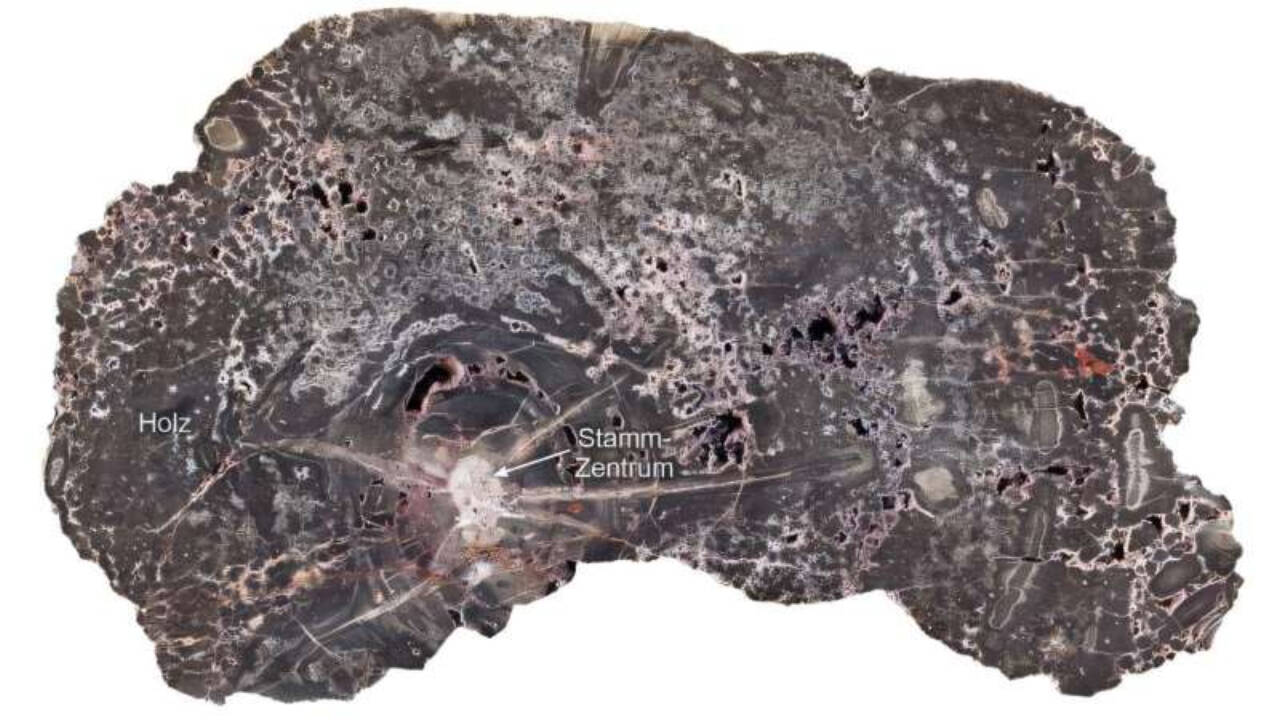
The study was based on fossilized tree trunks discovered in the Kyffhäuser mountains in northern Thuringia, Germany. Some of these trunks are up to 20 metres (66 feet) long and have been known to scientists since at least the 18th century. The area wasn’t like modern Europe about 300 million years ago. It was located in the supercontinent Pangaea near the equator, in a tropical, seasonally dry climate, where tropical dry forests flourished. These giant conifer-like trees grew up by ancient rivers and were then buried by floods under reddish sediments known as fluvial redbeds. According to the report, these deposits subsequently became a part of the Saale Basin, one of the oldest geological basins of the Central European Basin System.
All about the secret
Silica-rich groundwater seeped into the buried trunks
It’s not the wood itself that makes these fossils so special, but the quartz that slowly replaced the wood in the process of fossilization. The trees died, and the silica-rich groundwater seeped into the buried trunks. Over millions of years this silica crystallized into quartz, preserving even the microscopic details of the original wood, and creating a permanent geological record. Rather than forming in one sudden event, they found the quartz formed in five different stages, each one representing a different chapter in the geological history of the region. Each layer recorded key data on the temperature, pressure and chemical composition of the underground fluids present when it formed.
The journey of 5 kilometers under the Earth
By studying the quartz, scientists could construct a stunning 200-million-year timeline stretching from the late Carboniferous to the Early Cretaceous period. Including later uplift of the rocks, the record covers nearly 300 million years. One of the most extraordinary findings was that some of the fossilized wood had been buried 3 to 5.5 kilometers (1.9–3.4 miles) below the surface. Temperatures there varied from 160°C to 240°C (320°F–464°F). And it has been reported that instead of destroying the fossils, these extreme conditions were recorded forever in tiny quartz crystals, capturing evidence of burial, heating, and the region’s eventual return to the surface.
How did the researchers find it all
The journey of 5 kilometers under the Earth
According to the study, researchers used a combination of high-tech scientific techniques including quartz cathodoluminescence, Raman thermometry, oxygen and silicon isotope analysis, scanning electron microscopy, electron-probe microanalysis, fluid inclusion studies and in situ U-Pb dating to unlock this ancient archive. One of the most telling clues were microscopic fluid inclusions, tiny bubbles of fluid trapped inside the growing quartz crystals millions of years ago. These small pockets collected samples of the ancient fluids that once flowed underground, providing scientists a means of determining the exact temperatures and pressures at the time each layer of quartz formed.
A new window into the past
“The discovery changes the way scientists view fossilized wood,” Dr Trümper says. What was once considered mainly a record of ancient plant life can now be a geological archive that can document tectonic movements, basin subsidence, heating events and continental evolution over enormous time scales. This is the longest known sequence of successive stages of wood mineralization ever discovered, and it makes fossilized wood a new, important resource for Earth scientists, researchers say.Images Courtesy: University of Münster and istock