[ad_1]
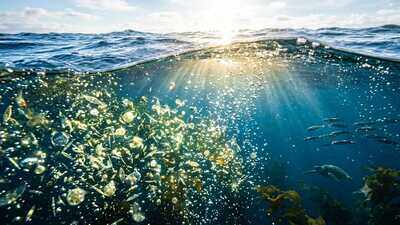
The first place people consider when thinking about the source of the oxygen that humans breathe is usually the big rainforest areas like the Amazon. Although forests play a very important role in storing carbon and conserving biodiversity and climate, the oceans provide a greater share of the oxygen in the atmosphere than forests. Almost half of the oxygen generated on earth is generated by oceans. According to the US National Oceanic and Atmospheric Administration (NOAA) Ocean Service, these tiny organisms form the foundation of marine ecosystems while quietly generating the oxygen that sustains life across the planet.
Microscopic phytoplankton are the ocean’s oxygen factories
In the oceans, more than 70% of the available oxygen is produced by the process of photosynthesis through tiny organisms called phytoplanktons.They exist on the top surface of the ocean and depend on sunlight, water, and carbon dioxide for the process of photosynthesis to produce oxygen. As per the National Oceanic and Atmospheric Administration (NOAA), Ocean Service, it has been found that these minute organisms are responsible for producing 50% or even more oxygen on the earth, which is invisible to the naked eye.
Why the Amazon isn’t called the planet’s ‘lungs’
The Amazon rainforest is often referred to as the “lungs of the Earth”, but scientists say the description can be misleading.Forests certainly produce oxygen through photosynthesis, yet they also consume large amounts of it through respiration by plants, animals and microorganisms, as well as through the decomposition of dead organic matter. Over long periods, much of the oxygen produced within mature forests is balanced by these natural processes.By contrast, the ocean’s vast populations of phytoplankton continuously contribute enormous quantities of oxygen to the atmosphere while also forming the base of marine food webs. As NOAA Ocean Service explains, marine photosynthesis plays a central role in maintaining the balance of atmospheric gases that support life on Earth.
The tiny organisms that support entire ecosystems
Besides producing oxygen, phytoplanktons perform many other roles. These are the first organisms in the food chain of the ocean, serving as food for tiny animals called zooplanktons which become food for fishes, whales, birds and other marine creatures.As the vast majority of life in the ocean either feeds directly or indirectly on phytoplanktons, it is important to know that the condition of phytoplanktons affects the performance of fishing grounds and marine ecosystems across the world.In addition to their ability to take out carbon dioxide from the air by photosynthesis, phytoplanktons contribute significantly to Earth’s carbon cycle by sending some of the captured carbon to the bottom of the ocean.
Why protecting the ocean protects the air we breathe
Although the ocean produces an extraordinary share of the planet’s oxygen, marine ecosystems face increasing pressure from climate change, pollution, ocean acidification and rising sea temperatures. These changes can alter phytoplankton populations and disrupt the delicate balance of marine ecosystems.Scientists continue to monitor phytoplankton using satellites, research vessels and ocean observatories to better understand how environmental change may affect their abundance and productivity. According to NOAA Ocean Service, protecting healthy oceans is essential not only for marine biodiversity but also for maintaining one of Earth’s most important natural systems for oxygen production.
A reminder that every second breath begins at sea
The ocean’s contribution to life on Earth often goes unnoticed because its greatest oxygen producers are microscopic. Yet every day, trillions of phytoplankton quietly convert sunlight into oxygen, supporting humans and countless other species.While forests remain indispensable for biodiversity, climate regulation and carbon storage, the evidence shows that the ocean is equally vital to our survival. The next time you take a breath, there is a good chance that the oxygen came not from a forest, but from tiny drifting organisms floating near the surface of the sea.
[ad_2]
Source link