[ad_1]
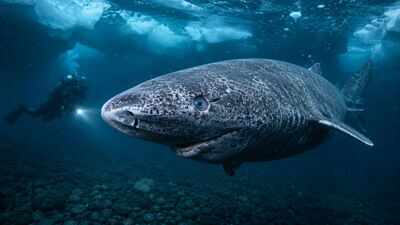
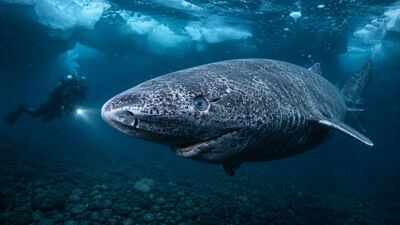
Greenland sharks entered popular science writing on the strength of one number, 400 years. Some individuals swimming in the North Atlantic today were alive during Isaac Newton’s lifetime, born centuries before anyone thought to ask how old a shark could get. That figure alone would be enough to make the species a fixture of “strange but true” science coverage, alongside the immortal jellyfish and the bristlecone pine.What usually got attached to the longevity claim, almost as a footnote, was a second one: that the sharks spent those centuries essentially blind, their eyes clouded and colonised by a permanently attached parasite. The two claims travelled together for years, so often that they came to feel like a single fact rather than two separate findings with very different levels of evidence behind them.
How scientists discovered Greenland sharks can live for nearly 400 years
According to the 2016 study published in Science, titled ‘Eye lens radiocarbon reveals centuries of longevity in the Greenland shark (Somniosus microcephalus)’, radiocarbon dating was conducted on the eye lens nuclei of 28 female Greenland sharks, ranging from 81 to 502 centimetres in length. The lens nucleus forms during embryonic development and does not turn over afterwards, so the carbon-14 trapped at its centre reflects atmospheric conditions at the time of the shark’s birth.The results estimated a minimum lifespan of 272 years, with the largest shark in the sample dated at 392 years, plus or minus 120. The findings show the Greenland shark is “the longest-lived vertebrate known”. That is a well-supported, peer-reviewed conclusion. The blindness claim, by contrast, comes from an entirely different body of work, and it has just been substantially revised.
How the myth that Greenland sharks are blind spread over the years
The idea traces back to research on Ommatokoita elongata, a parasitic copepod that attaches to the shark’s cornea and is extremely common in the species. A 1998 paper by Borucinska and colleagues, examining infected eyes from sharks caught off the Canadian Arctic, described the ocular damage the parasite causes and raised the possibility of impaired sight. Over the following two decades, that cautious possibility hardened into an accepted fact in popular retellings, repeated so often that the qualifier disappeared entirely.By the time the claim reached mainstream science writing, “may impair vision” had become “the sharks are functionally blind.” It is a familiar pattern in how received wisdom forms about animals that few people ever see up close, in habitats few researchers can easily reach. Nobody had actually tested whether the shark’s visual system still worked. That test has now been done.
Scientists discover Greenland sharks retain healthy vision despite centuries of life
According to the 2026 study published in Nature, titled ‘The visual system of the longest-living vertebrate, the Greenland shark’, using genomic, transcriptomic and histological analysis, they found that the species “retains an intact visual system well-adapted for life in dim light“, with functioning rod cells, active phototransduction genes and no visible retinal degeneration, even in specimens estimated to be more than a century old. The team also tested corneas taken directly from parasitised sharks and found that light still passed through them, reaching the retina despite the copepods attached at the edges.The researchers propose that elevated expression of DNA repair genes in the retina may be what allows this preservation to hold up over such an extreme lifespan, a mechanism recently observed in another long-lived species, the bowhead whale. The shark is not a blind, ancient drifter carrying centuries of darkness. It is an animal whose visual system has been actively maintained for far longer than researchers assumed possible, and the “why” of that maintenance is now the more interesting open question.
[ad_2]
Source link