[ad_1]
Snakes represent one of the most successful groups of vertebrates on Earth, with over 4,200 living species accounting for one-third of all scaled reptiles. Despite a long history going back to at least the Middle Jurassic, the exact environmental origins of these creatures have remained a subject of debate. Finding the truth is difficult because the fossil record for early snakes is very poor, and the physical changes they went through, often hide their ancestral roots.Until now, fewer than 10 articulated snake fossils were known from the Mesozoic era, with only three preserved in three dimensions. However, a newly discovered 80-million-year-old fossil from Brazil is bringing new dimensions to the field. By revealing the secrets of an ancient brain, this discovery provides evidence that early snakes were more ecologically diverse than once thought.
Why is the Brazilian fossil of Tametara mirim so important
The discovery of a new ‘3D-preserved stem snake species from the Late Cretaceous’ marks a major milestone in palaeontology. Found recently in south-eastern Brazil, the species has been named ‘Tametara mirim.’According to the study published in ‘Nature,’ earlier Brazilian snake fossils from the Cretaceous period, such as Seismophis and Boipeba, were only known from isolated vertebrae. This makes Tametara the first articulated snake fossil (made with joints or connected sections that allow parts to bend or move) ever found in Brazil. Its skeleton is strictly preserved, which offers a rare opportunity for scientists to study the skull as well as the postcranial material of a creature that lived roughly 80 million years ago.The most amazing aspect of this find is the high-resolution preservation. As highlighted in the study, this specimen has allowed scientists to create the most detailed reconstruction of a stem snake brain endocast to date. Such detailed scans provide new insight into how snake skulls evolved. Applying methods including geometric morphometrics and bone microstructure analysis, the research team showed that Tametara is a unique example of a ‘burrowing snake.’ This finding is significant because it quantitatively supports the notion that some of the earliest snakes were adapted for life underground.
What does the brain scan of the snake’s fossil reveal about its senses
In the past, scientists only had a handful of 3D fossils, such as Dinilysia patagonica from Argentina and Sanajeh indicus from India, to help them understand how ancient snakes lived. The Nature study notes that these fossils were vital for understanding limb reduction and body elongation, but they didn’t tell about the snakes’ preferred environments. Scientists wondered whether the earliest snakes were primarily aquatic, terrestrial, or burrowing creatures.By looking at the brain, researchers can now see a much clearer picture. As highlighted in the research study, postdoctoral researcher Simone Macrì and Research Director Nicolas Di-Poï from the University of Helsinki used computed tomography and 3D rendering to create a digital map of the snake’s brain. This reconstruction allowed them to connect the internal anatomy of the snake with its sensory abilities. Macrì noted that the brain tells a much more interesting story than the skeleton. The study showed that these ancient creatures were actually experimenting with various sensory and ecological strategies from early on.
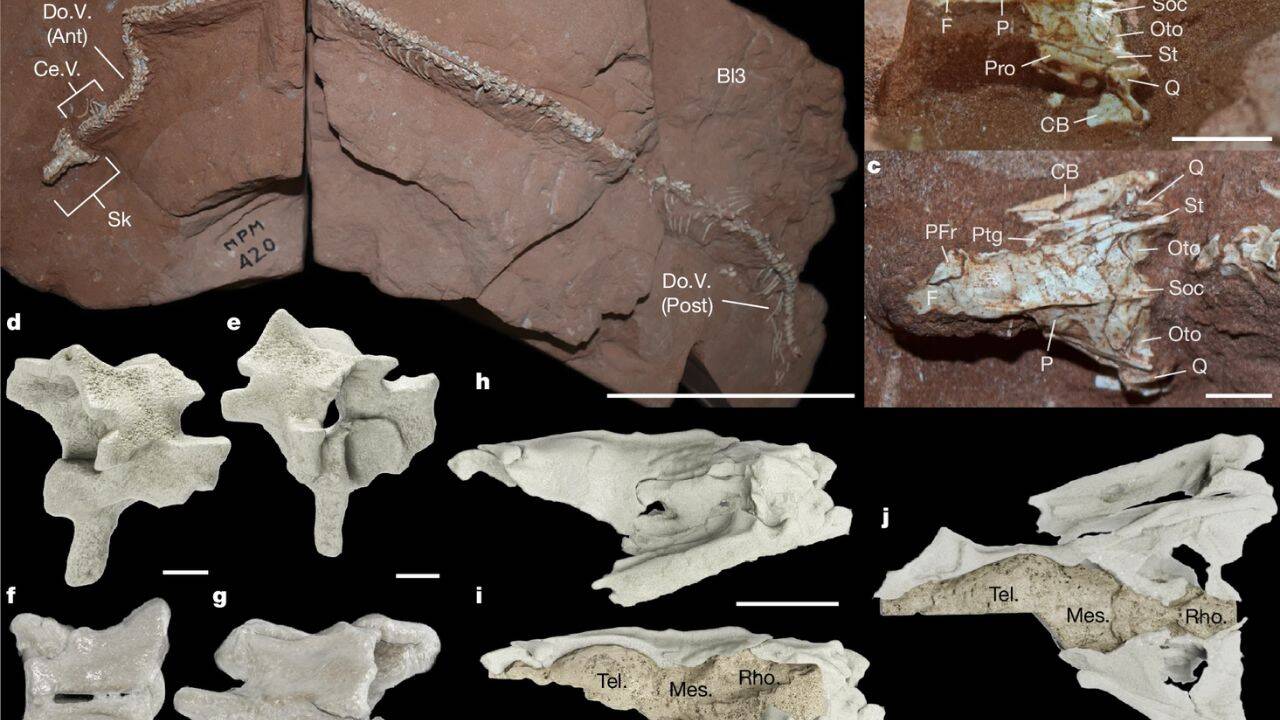
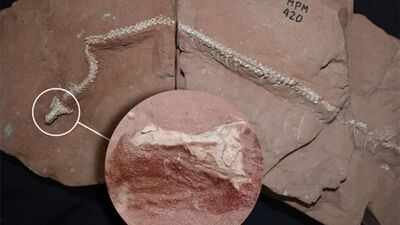
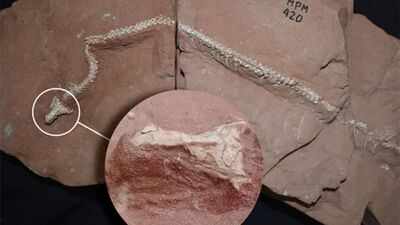
Holotype (MPM 420) of T. mirim. Image Credit: Nature.com
How do these findings reshape our understanding of ancient snake habitats
The research led by Tiago Simões, an Assistant Professor at Princeton University, has shifted the debate over snake origins. For many years, the scientific community was divided between two main theories: one suggesting snakes evolved their long bodies to live underground, and another saying that they adapted for life in the water. However, the research article reports that by 80 million years ago, separate lineages of snakes were already exploring a wide range of habitats, including underground, terrestrial, as well as marine environments.The team conducted a comparative study between Tametara and the Argentinian fossil Dinilysia patagonica. They found that the two species had different brain shapes, which suggested they lived in very different ways. While the brain shape and bone structure of Tametara pointed toward a burrowing lifestyle, Dinilysia appeared to be an on ground creature. Together with evidence from fossils found in marine sediments, these results prove that early snakes were not confined to a single ecology.
Why was ecological experimentation crucial for ancient snakes
The concept of ‘ecological experimentation’ is a major takeaway from this research. The study emphasises that the case of burrowing seen in Tametara highlights how early snakes were testing different ways to survive. Instead of following a single path, different snake lineages developed unique adaptations according to their specific ecology. This diversity in form and function allowed snakes to colonise almost every corner of the globe.The international team of collaborators, which included researchers from the University of São Paulo and other institutions, has shown that the Late Cretaceous was a period of remarkable diversity for snakes. ‘By 80 million years ago snakes had already developed a remarkable morphological and ecological diversity,’ said lead author Tiago Simões. This research also settles the long-standing debate about whether the first snakes were terrestrial or marine animals. Our knowledge of these diverse reptiles will only increase as more fossils are found and scanned.
[ad_2]
Source link