[ad_1]
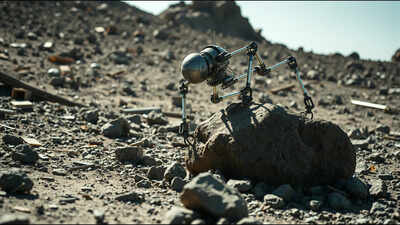
Ankan Das is a 15-year-old sophomore at Oviedo High School in Florida, but his latest science-fair project looks more like something from a robotics laboratory than a school classroom. For his Regeneron International Science and Engineering Fair project, Das built a compact robot with a flexible, icosahedron-shaped frame that can absorb impacts, change shape and move across different surfaces. Instead of conventional wheels or legs, the robot uses a tensegrity structure made from rigid rods and tensioned cables, allowing its body to deform rather than remaining fixed in one position. Das designed the machine with difficult environments in mind, including search and rescue, surveillance and planetary exploration. He built the system with the possibility of eventually operating multiple robots as a swarm. At ISEF 2026, the robot successfully traversed simulated lunar soil, concrete and pavement, demonstrating how a relatively small and unconventional machine could tackle terrain that would challenge more rigid designs.
How a tensegrity structure lets Ankan Das’s robot bend and absorb impacts
According to the official ISEF project page, Das’s robot uses a tensegrity frame, a structural design in which rigid elements are held in position by a network of tensioned members. This gives the robot a compliant body that can deform when it encounters an obstacle or lands after a fall rather than transferring all of the force through a rigid chassis.The robot is actuated using shape-memory alloy springs. These materials contract when heated by an electrical current and return toward their original configuration as they cool. Das used the contraction of the springs to change the robot’s shape and generate movement. The result is a machine that does not need a conventional set of wheels or articulated legs to move. Instead, carefully controlled changes in tension across its frame allow the entire structure to shift and propel itself forward.
Why Das built the robot in an icosahedron shape
The robot’s unusual geometry is central to the design. An icosahedron has 20 triangular faces, giving the machine a roughly spherical structure without a permanently defined top or bottom. That allows it to continue functioning after landing on different sides of its frame rather than requiring a particular orientation. Das also integrated the electronics needed to control the robot’s movement, including a microcontroller and systems for switching and powering the actuators. The robot can be controlled wirelessly, allowing individual actuators to be triggered to change its direction.Its relatively compact design is another advantage. Rather than building a large machine capable of climbing over every obstacle, Das designed a robot that can change its shape and potentially move through spaces that would be inaccessible to a conventional rigid vehicle. The project therefore prioritises adaptability and resilience over speed. That trade-off is particularly relevant to environments where obstacles, uneven ground and unpredictable impacts could matter more than covering large distances quickly.
Why simulated Moon soil was used to test the robot
One of the most interesting parts of Das’s project was testing the robot on simulated lunar soil, known as regolith. The Society for Science says the robot successfully traversed simulated lunar soil as well as concrete and pavement. Testing on regolith matters because loose granular surfaces behave very differently from solid pavement. Wheels can lose traction and conventional mechanisms can struggle when particles shift beneath them. A robot that can continuously reshape its body has the potential to respond differently to those changes in terrain.The lunar testing does not mean Das’s robot is currently ready for deployment on the Moon. Rather, simulated lunar soil provides a particularly demanding test environment for the type of mobility and adaptability he is trying to achieve. The project was one of the 2026 Regeneron ISEF finalists, with Das listed under Engineering Technology: Statics and Dynamics. The Society for Science’s 2026 lunar-research roundup specifically highlighted his robot among projects inspired by lunar exploration.
What Das’s robot could eventually be used for
The potential applications extend beyond space exploration. Das designed the platform with search and rescue, surveillance and other difficult environments in mind. Its ability to absorb impacts and change shape could be useful in places where a conventional wheeled robot might become stuck or damaged. Das also envisioned multiple robots eventually working together as a swarm. Instead of relying on one sophisticated machine to complete an entire mission, a group of smaller robots could potentially spread across an area, navigate around obstacles and share the work. That idea is particularly interesting for environments that are difficult or dangerous for humans to enter. A swarm of inexpensive, adaptable robots could theoretically investigate damaged structures, search difficult terrain or explore unfamiliar landscapes while reducing the risk to people.For now, however, the project remains a student-built research prototype rather than an operational lunar vehicle. What makes it notable is the engineering principle behind it: instead of making a robot stronger by making it more rigid, Das has explored whether making the robot flexible, deformable and capable of recovering from impacts can make it more useful. At 15, he has already taken that idea from a design concept to a working machine capable of moving across several very different surfaces, including simulated Moon soil.
[ad_2]
Source link