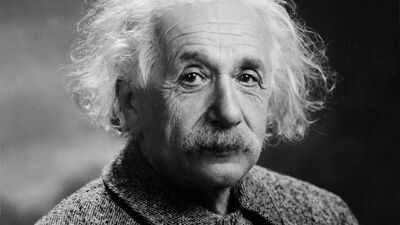
There is a difference between knowing something and being able to see what might come next. Knowledge gives people facts, experience and established ways of understanding the world. Imagination works in a less certain space, where an idea can be considered before there is evidence to prove whether it will work. Albert Einstein often spoke about this relationship between what is known and what can be imagined. His famous observation, “Imagination is more important than knowledge. Knowledge is limited. Imagination encircles the world,” has since become one of his most widely repeated remarks. Yet the quote is not simply an argument for creativity over education. Einstein’s own scientific career suggests something more measured: knowledge provides the foundation, while imagination can help a person question familiar ideas, connect information in new ways and consider possibilities that have not yet been tested.
Quote of the day by Albert Einstein
“Imagination is more important than knowledge. Knowledge is limited. Imagination encircles the world.”
What Einstein meant by imagination
Imagination, in this context, does not simply mean fantasy. Einstein’s use of the idea is closer to the ability to construct possibilities in the mind before they can be tested in the physical world.A scientist may imagine what would happen under conditions that cannot easily be created in a laboratory. A writer can picture a situation before putting it into words. An engineer can think through a machine that has not yet been built. A mathematician can work with an idea long before its practical application becomes apparent.That is why imagination can operate beyond the boundaries of established knowledge. It asks a different question. Instead of only asking, “What do we know?”, it asks, “What could be possible if this were true?”
Why knowledge still matters
Taken literally, the quote can sound as though Einstein considered knowledge unimportant. That would miss the point.Imagination without knowledge has limits of its own. A new scientific idea still needs mathematics, evidence and testing. An invention has to work within the properties of materials and physical systems. Even an unusual hypothesis has to be examined against what is already known.Einstein spent years working with highly developed mathematical and scientific knowledge. His breakthroughs did not come from ignoring established ideas. They involved looking at familiar principles from a different angle.The useful distinction, then, is not imagination versus knowledge. It is imagination working beyond the edge of what is already known, with knowledge providing the ground from which that movement begins.
Einstein’s early life and scientific career
Albert Einstein was born in Ulm, in the German Empire, in 1879. His family later moved to Munich, where he spent part of his childhood before eventually continuing his education in Switzerland.He studied at the Swiss Federal Polytechnic in Zurich and graduated in 1900. His academic career did not immediately follow the path that later made him famous. In 1902, he took a position at the Swiss Patent Office in Bern.The job gave him a stable income while he continued thinking about theoretical physics outside his official duties. In 1905, often described as Einstein’s annus mirabilis, he published several papers that had a lasting effect on physics. They dealt with subjects including Brownian motion, the photoelectric effect and special relativity.His later work on general relativity transformed the understanding of gravity by describing it through the geometry of space and time. Einstein eventually became one of the most recognisable scientists of the 20th century.
What the quote says about learning
The quotation also changes how learning can be understood. Memorising information gives people a larger store of material, but it does not automatically teach them what to do with it.A student who understands a principle can begin asking what would happen if one of its conditions changed. A programmer can take an existing method and wonder whether it could be applied somewhere else. A historian can look at familiar evidence and consider an interpretation that has not previously been explored.Learning becomes more useful when information can be connected rather than simply retained.There is a practical reason for this. Most new ideas do not arrive as completely isolated discoveries. They often emerge when existing pieces are combined in an unfamiliar way.
Lessons learnt from Einstein’s quote
- Knowledge is a starting point, not the final destination.
- Ask questions beyond the obvious.
- Creativity needs knowledge behind it.
- Do not be limited by established thinking.
- Give new ideas time to develop.
- Imagination can turn learning into discovery.
- Facts and imagination work best together.
- Intelligence also involves seeing possibilities.
- Question assumptions instead of accepting them automatically.
- Look beyond what is already known.
- Use knowledge to explore unfamiliar possibilities.
- Be open to ideas that challenge conventional thinking.
Why the idea still matters
The relationship between imagination and knowledge has not disappeared as technology has advanced. If anything, the distinction is visible in more areas of work. Computing, medicine, engineering and design all depend on people who can work with information while also considering possibilities that are not yet part of the accepted solution. Large amounts of data can describe patterns, but data does not by itself decide which question should be asked next.The same applies outside science. Businesses develop new products by imagining uses that customers may not have considered. Architects explore buildings before those buildings exist. Filmmakers construct entire worlds from ideas that begin as sketches and fragments.In each case, knowledge supplies constraints as well as possibilities. Imagination works within those constraints, tests them or occasionally challenges them.