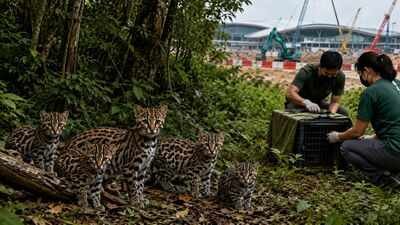
For months, the forest around Changi was being watched after dark. More than 50 volunteers, working with conservation groups and Singapore’s National Parks Board, set up cameras, collected evidence and searched for signs of one of the country’s most elusive wild cats. What they found was more significant than a handful of fleeting sightings. By the time the survey ended in April 2026, five leopard cats had been identified, including cubs; evidence that the animals were breeding in the forest.But the discovery comes at a difficult moment. The landscape around Changi is changing as construction of the new Terminal 5 and planned coastal reclamation reshape parts of the habitat. For the cats, finding them was only the beginning. Now, conservationists face the harder task of moving them to places where they can continue to hunt, roam and reproduce without being squeezed out by development.
How a volunteer survey revealed a breeding population of leopard cats in Changi
The Changi population had been known about for several years, although its size and behaviour were less clear. The first confirmed evidence came in January 2019, when a leopard cat was killed in a road accident. The animals are believed to have reached mainland Changi from nearby Pulau Tekong, apparently by swimming across the strait.A more detailed effort began in July 2025. The Singapore Wildcat Action Group, working with the National Parks Board, organised a survey of the coastal forest with help from more than 50 volunteers. They ranged in age from 10 to 83.The work was largely carried out after dark, when leopard cats are active. Volunteers installed 18 motion-sensor cameras along the coastline and kept them operating over an extended period. They also collected faecal samples, adding another way of identifying and studying the animals without having to capture them.By the time the survey ended in April 2026, five leopard cats had been identified. Among them were cubs, the first seen in the area in more than ten years. For conservationists, that provided evidence that the Changi habitat had supported breeding, rather than simply being a temporary stop for passing animals.
Why Singapore’s leopard cats are running out of safe places to roam
Leopard cats are not rare across much of their wider Asian range. Singapore is different. Here, the species is considered critically endangered, with the remaining population scattered across a handful of areas including Pulau Tekong, Pulau Ubin and the Western Catchment.Their small size can make them easy to overlook. They are mostly nocturnal and tend to stay away from people, moving through forest and other areas in search of prey. That makes road crossings particularly hazardous in a city where remaining natural habitats are often separated by roads and developed land.At least five leopard cats have been killed by vehicles in Singapore over the past 25 years, according to the Singapore Wildcat Action Group. As forest patches become smaller or disconnected, the likelihood of animals encountering roads can increase.For the Changi cats, there is another problem: the habitat itself is being altered.
Why Changi’s changing landscape could leave leopard cats with too little space
Construction of Changi Airport Terminal 5 is taking place in the wider area, while land reclamation is also planned along the coast. These changes mean that the existing forest will not remain in its present form.Mammal scientist Marcus Chua, who is advising the conservation work, said the remaining forest would not be large enough to sustain the cats as development continued. Chua said, “With the amount of forest remaining and knowledge that development in the area would continue, it was clear that the existing area would not be able to support a population of leopard cats”.Simply fencing off parts of the landscape would not solve all of those problems. The cats would still face shrinking feeding grounds, competition for resources and the danger of crossing roads.
The new homes for Changi’s leopard cats are being chosen with care
The authorities have not disclosed where the leopard cats will be released. Keeping those locations private is intended to reduce the risk of unwanted attention, including from people who might try to capture the animals.The sites are being selected with input from the Singapore Wildcat Action Group and Chua. They need to provide enough forest cover, an adequate supply of prey and connections to other suitable areas. That last point matters because an isolated patch of forest may provide shelter but still leave the animals with few chances to disperse or find mates.The move will not be carried out as a single mass transfer. NParks and the group said the cats will be relocated progressively, with trained professionals involved in trapping them and monitoring continuing after release. Techniques and experience from leopard cat relocations elsewhere, including Taiwan, are being considered as part of the process.Before any animal is released, veterinarians from NParks and Mandai Wildlife Group will examine it to assess its condition.
The community helped uncover what was there
The Changi survey also illustrates how much can be learned when members of the public take part in wildlife monitoring. The volunteers were not simply recording occasional sightings. They maintained camera stations, collected samples and spent months building up a picture of animals that are rarely seen during daylight.For NParks, the project demonstrated how community-led science can feed into formal biodiversity planning. The information gathered gave conservation authorities a clearer understanding of the size of the Changi group and helped shape the decision to relocate it.
Relocation is only part of the conservation question
The immediate plan is to give the five Changi leopard cats a better chance of surviving as their existing surroundings change. The longer-term issue is how Singapore manages a species whose remaining habitats are fragmented and whose population is already small.The Singapore Wildcat Action Group has called for a national species action plan for leopard cats, something that does not yet exist. Its co-founder Vilma D’Rozario said the Changi operation could help bring the different groups involved in wildlife management towards a broader conservation strategy.For now, attention will turn to the relocation itself. The cats will have to be captured without unnecessary stress, assessed by veterinarians, transported and released into unfamiliar territory. Their movements and condition will then need to be followed to see whether the new habitats provide what the Changi forest once did.The five animals are a small part of Singapore’s remaining wildcat population. Their survival will depend not only on where they are moved, but on whether the habitats around them remain connected and safe enough for a species that needs space to move through the landscape.