[ad_1]
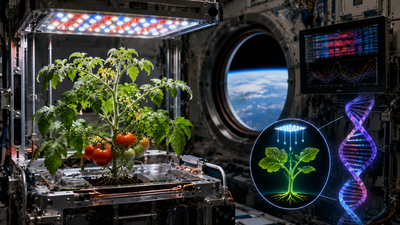
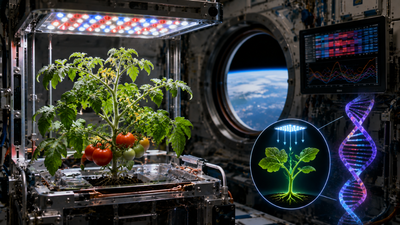
A tomato plant carries thousands of genes that stay largely quiet under normal growing conditions. Send that plant into orbit, however, and a striking number of them switch on or off within weeks. New research examining ‘Red Robin’ tomatoes grown aboard the International Space Station has found that once gravity is taken out of the equation, plants lean on light as their main organising cue, and the colour of that light determines how the genome responds. According to the study published in BMC Plant Biology, titled ‘Stress and light spectral quality influence the transcriptome of a tomato crop on the International Space Station’, red-rich lighting kept gene activity comparatively steady during spaceflight, while blue-rich lighting drove far greater volatility across leaf and root tissue. The same plants also grew unusually extensive roots along their stems, a stress response rarely seen at this scale in ground-based tomatoes. Together, the findings offer one of the clearest pictures yet of how a fruiting crop, rather than a simple laboratory plant, rewires its biology to survive without gravity.
Why did plants switch thousands of genes in space
On Earth, plants use gravity as a fixed reference point, directing roots downward and shoots upward through a process called gravitropism. Remove that reference point, and a plant has to fall back on other environmental cues to organise its growth. The tomato plants grown aboard the ISS relied heavily on light spectral quality to compensate for the missing gravitational signal, with red and blue wavelengths triggering markedly different genetic responses depending on whether the plants were in orbit or on the ground.The scale of the transcriptional shift was substantial. Researchers sequenced RNA from leaf and adventitious root tissue and identified extensive differential gene expression between flight and ground-grown samples, with more genes upregulated than downregulated in spaceflight tissue across nearly every comparison. In the leaves alone, 198 genes showed shared differential expression between red-rich and blue-rich lighting treatments, while adventitious roots showed an even larger shared set of 305 genes, pointing to a coordinated but tissue-specific reprogramming of the plant’s genetic machinery in microgravity.
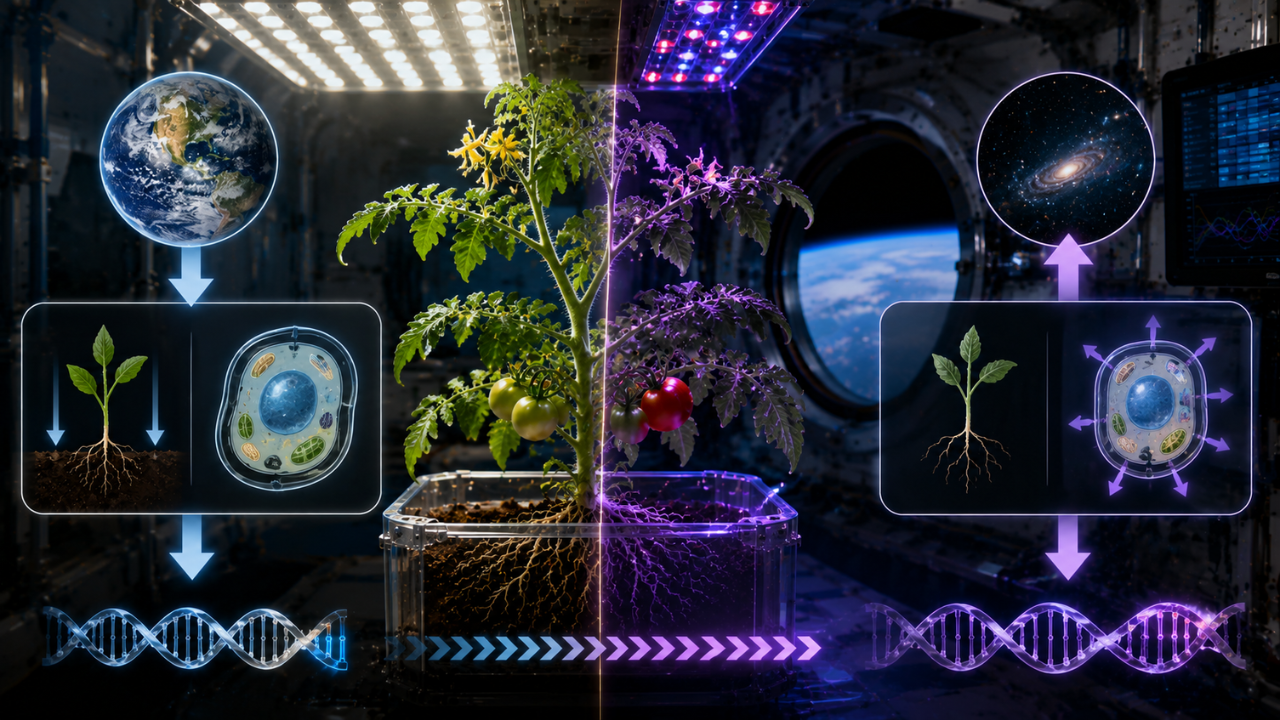
Image AI generated
How did red and blue light change plant growth
Plants grown under blue-rich lighting in orbit displayed considerably more variation in gene expression than those grown under red-rich lighting, a pattern confirmed through several independent analyses including principal component analysis, gene-level variance measurements, and fold-change comparisons. Red-rich light, by contrast, appeared to constrain and stabilise the plant’s transcriptional response, regardless of whether the tomatoes were flown to space or kept on Earth.This divergence has been linked to how plants perceive different wavelengths at a molecular level. Blue light is detected by photoreceptors called cryptochromes and phototropins, which coordinate processes including chloroplast development and stress signalling, whilst red light is sensed mainly through phytochromes, which govern photosynthetic activity and structural stability. Although the receptor genes themselves did not show strong differential expression, downstream targets such as HY5 homologues and flavonoid biosynthesis genes were altered under flight conditions, suggesting that microgravity disrupts the signalling pathways that these light receptors normally control rather than the receptors themselves.
Why did tomato plants grow more roots in space
One of the most visible effects of spaceflight on the tomato plants was the formation of unusually extensive adventitious root structures that emerge from stems rather than from a plant’s primary root system. This above-ground root growth was far more pronounced in ISS-grown plants than in ground controls, echoing a response typically seen on Earth when plants face flooding, low-oxygen conditions, or poor nutrient availability.Gene activity in these root tissues told a consistent story. Spaceflight samples showed strong upregulation of genes governing auxin transport, ethylene biosynthesis, and the breakdown of reactive oxygen species, alongside genes involved in remodelling the plant cell wall, a pattern consistent with a stress-driven developmental response. The blue-rich lighting condition intensified this reaction further, amplifying the expression of stress-related transcription factors and metabolic genes, indicating that light quality does not just influence stability but also shapes how forcefully a plant responds to the physical stresses of orbit.
How are tomatoes different from Arabidopsis in space
Much of what is currently understood about plant behaviour in space comes from Arabidopsis, a small flowering plant frequently used in laboratory research. Tomato plants displayed transcriptional changes that were more tissue-specific and more pronounced in specialised structures such as adventitious roots than have typically been observed in Arabidopsis, indicating that different plant species may rely on distinct adaptive strategies when grown away from Earth’s gravity.The implications extend past the confines of the space station. Insights into how tomatoes manage oxidative stress, hormonal signalling, and nutrient transport under spaceflight conditions could inform breeding strategies for crops grown in challenging environments on Earth, including regions affected by flooding or nutrient-poor soil. As missions look toward longer stays away from Earth, understanding how to stabilise crop gene expression through lighting design, favouring red-rich regimes for more predictable growth, is being treated as a practical step toward sustaining fresh food production during future space travel.
[ad_2]
Source link