[ad_1]
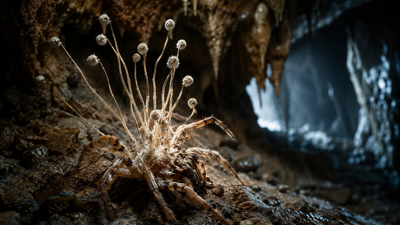
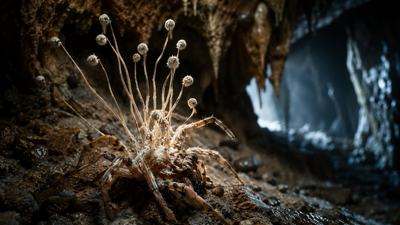
A new species of fungus capable of manipulating spiders before killing them has been formally identified in caves and disused buildings across Northern Ireland, the Republic of Ireland and Wales, marking one of the first confirmed cases of such behavioural control found in a temperate climate. Named Gibellula attenboroughii in honour of the broadcaster Sir David Attenborough, the fungus was first noticed on a spider filmed during the BBC’s Winterwatch series in 2021, when the creature was spotted in an unusually exposed position rather than hidden within its web. Years of fieldwork, laboratory culturing and genetic sequencing followed, allowing researchers to confirm the fungus as a species new to science and to trace its effects across multiple cave systems. According to the study, published in PubMed, titled ‘The araneopathogenic genus Gibellula (Cordycipitaceae: Hypocreales) in the British Isles, including a new zombie species on orb-weaving cave spiders (Metainae: Tetragnathidae)’, infected spiders consistently died in prominent, airflow-exposed spots, a pattern strikingly similar to that seen in tropical “zombie ant” fungi. The findings suggest such behavioural manipulation is far more widespread, and far closer to home, than previously understood.
How did scientists discover the new zombie fungus in British caves
The fungus first came to scientific attention almost by accident. A fungal-infected spider was discovered on the ceiling of an abandoned gunpowder store at Castle Espie Wetland Centre in County Down during the 2021 filming of Winterwatch, and images sent to the study’s senior author suggested it represented a species new to science. The host was later identified as Metellina merianae, a cave-dwelling orb-weaving spider, and its position out in the open rather than tucked away in a web was noted as an early sign of unusual behaviour.That initial sighting was followed up during the 2022 Springwatch series, after which the specimen was removed for formal identification. Researchers subsequently searched cave systems across the island of Ireland, working with a local speleologist to locate further infected spiders. Additional specimens were recovered from two orb-weaving spider species found in cave systems in County Fermanagh and County Cavan, allowing the team to compare infections across different hosts and locations before reaching firm conclusions about the fungus’s identity.
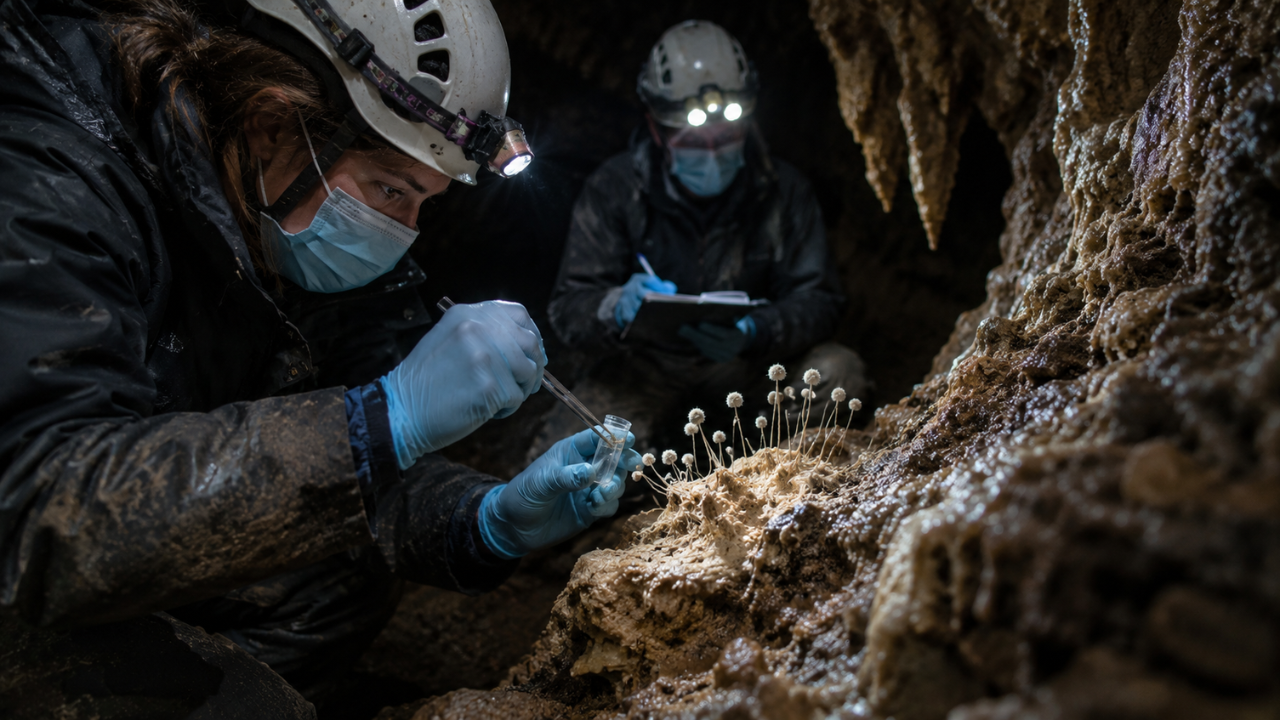
Image AI generated
How did scientists confirm the new zombie fungus
Establishing that the fungus was genuinely new required more than visual inspection. Samples were cultured on agar plates, and their DNA sequenced across several genetic markers, including regions of ribosomal DNA and the translation elongation factor gene, before being compared against related fungi in the genus Gibellula using phylogenetic analysis. The resulting family tree placed the British and Irish specimens within their own distinct branch, closely related to but clearly separate from other members of the genus, which comprises fungi that are pathogenic on spiders and largely confined to tropical and sub-tropical regions.The formal description also documented the fungus’s physical characteristics in detail, from the white to cream-coloured spore-bearing structures, known as synnemata, that erupt from the spider’s body, to the microscopic shape of its spore-producing heads. Spiders found in different locations showed variations in colour and structure, which the authors attributed to differing light and airflow conditions within the gunpowder store compared with open cave systems, rather than to separate species. The fungus was named Gibellula attenboroughii in honour of the broadcaster Sir David Attenborough, credited with helping to establish the BBC’s Natural History Unit.
How does the zombie fungus control infected spiders
Central to the findings is the suggestion that infected spiders do not simply succumb to disease where they sit, but instead move to more exposed locations before dying. Infected spiders were consistently found on cave ceilings, walls and store roofs rather than in the concealed crevices or webs where these species would typically shelter, a pattern that closely mirrors behaviour already documented in so-called “zombie ant” fungi of the genus Ophiocordyceps. The study proposes that this shift in position is not incidental, but instead improves the chances that the fungus’s spores will be caught by air currents moving through the cave and carried onward to new hosts.This manipulation appears consistent across more than one spider species and across several separate cave systems, strengthening the case that it is a genuine feature of the fungus’s life cycle rather than a coincidence. The exposed death sites recorded at sites in Northern Ireland, the Republic of Ireland and Wales all shared this same characteristic, with infected spiders dying in prominent, airflow-exposed positions regardless of which of the two spider hosts, Metellina merianae or Meta menardi, was affected.
How did scientists find more Gibellula species
Beyond describing the new species, the study also revisited historical fungarium records and older literature on British spider-pathogenic fungi, much of which dates back to the work of the mycologist Tom Petch in the 1930s and 1940s. This review led to two further taxonomic revisions, with two fungi previously classified under the genus Torrubiella reclassified as Gibellula species based on their asexual growth forms, bringing the documented diversity of the genus in the British Isles to several distinct species rather than the single one long assumed to be present.The authors conclude that this hidden diversity points to a group of organisms that has been largely overlooked by British and Irish naturalists, despite occasional reports of large outbreaks stretching back decades. According to the study, previous unpublished sightings of heavy infection in Norfolk and Wales suggest that these fungi may periodically affect spider populations on a notable scale.
[ad_2]
Source link