[ad_1]
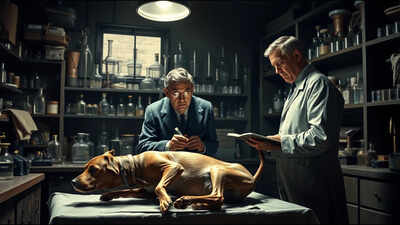
In May 1921, Frederick Banting arrived at the University of Toronto with an idea about diabetes and little laboratory experience. Professor John J.R. Macleod gave him space in the physiology department, several dogs and Charles Best, a young physiology student, as his assistant. They aimed to find the substance produced by the pancreas that appeared to regulate blood sugar. Banting and Best removed the pancreases of some dogs to produce diabetes artificially, while tying the pancreatic ducts of others so that the digestive part of the organ would deteriorate, leaving the insulin-producing islets behind. The work was difficult. Many of the animals died from complications and infection, and several of the duct-ligation operations failed. But on July 30, 1921, the researchers prepared their first pancreatic extract and injected it into a denervated dog known as Dog 410. Within an hour, its blood sugar had fallen from 0.20 per cent to 0.12 per cent, or about 200 to 120 milligrams per decilitre. Dog 410 died the following day, but the result gave Banting and Best their first clear evidence that they were on the right track.
How a July 1921 experiment showed that a pancreatic extract could lower blood sugar
The July 30 experiment was not the discovery of a finished medicine. It was the first convincing result in a series of increasingly systematic experiments. Dog 410 had been made diabetic by removing its pancreas, and the extract injected into it had been prepared from the degenerated pancreas of another dog whose pancreatic duct had been tied off. The first injection produced the sharp fall in blood sugar that caught Banting and Best’s attention, although subsequent injections that day produced less consistent results. The following morning, Dog 410 was found in a diabetic coma and died later that day. Two days later, another depancreatized dog, Dog 406, briefly improved after receiving the extract, with its blood sugar falling and the animal recovering enough to walk before it deteriorated again. Then came Dog 408, a yellow collie that received repeated injections of the extract from August 3 to 7. The experiments on these three dogs were imperfect, but together they convinced Banting and Best that the pancreatic extract had a real blood-sugar-lowering effect. They began referring to the substance as “isletin” in their laboratory notebooks.
Why the dog named Marjorie became central to proving the extract could sustain life
The dog that later became the best-known animal in the insulin story was Marjorie, or Dog 33, but she was not the animal involved in the July breakthrough. Her pancreas was removed on November 18, 1921, months after the first experiments. She was subsequently kept alive with repeated doses of the evolving pancreatic extract. Unlike Dog 410, whose response was brief, Marjorie survived for 70 days after her pancreas was removed. The University of Toronto’s scientific collections describe her survival as important evidence that the extract could sustain life in an animal without a functioning pancreas. By November, the researchers had also begun using pancreatic tissue from fetal calves, which offered a much more practical source of material than repeatedly preparing extracts from specially operated dogs. The work was moving from proof of principle toward finding a reliable way of producing enough active extract for further experiments. Marjorie’s prolonged survival became one of the strongest demonstrations that the substance they were extracting could replace a function the body had lost.
Why the famous rooftop photograph shows Dog 408, not Marjorie
One of the most persistent details in the popular story is also one of the easiest to get wrong. A famous photograph taken by Henry Mahon in August 1921 shows Banting and Best standing beside a dog on the roof of the University of Toronto’s Medical Building. For years, the animal was identified as Marjorie. It was not. The University of Toronto archive identifies the dog as Dog 408, and the Nobel Prize’s historical account makes the same correction. The dates alone expose the mistake: Marjorie did not enter the experiments until November, while Dog 408 was already being used in the pancreatic-extract trials in early August. Dog 408 received repeated injections of the extract and showed the blood-sugar-lowering effect that helped convince Banting and Best they had isolated something significant. The collie eventually died during the experiments, with an autopsy finding widespread infection. The photograph therefore captures the researchers during the early summer phase of the work, not the later period in which Marjorie became their longest-surviving test animal.
How the dog experiments eventually led to insulin treatment in humans
The experiments on dogs established that a pancreatic extract could replace a missing function, but turning that crude extract into a treatment suitable for people required further work. James Collip, a biochemist who joined the group later in 1921, worked on improving the extraction and purification process. By January 1922, the team was ready to begin clinical testing. The first patient was 14-year-old Leonard Thompson, who received the refined extract at Toronto General Hospital on January 11, 1922, but the initial preparation produced little improvement and caused an abscess. After Collip further purified the extract, Thompson was treated again on January 23, with a dramatic improvement in his condition. Insulin rapidly moved from an experimental preparation to a treatment that could keep people with severe diabetes alive. Banting and Macleod were awarded the 1923 Nobel Prize in Physiology or Medicine for the discovery of insulin; Banting shared his prize money with Best, while Macleod shared his with Collip. The story therefore belongs to more than one researcher and more than one dog. Dog 410 provided the first striking blood-sugar result, Dog 408 became the animal in the famous photograph, and Marjorie demonstrated that the extract could sustain an animal for an extended period. Together, those experiments formed part of the chain that eventually turned insulin into a lifesaving treatment for humans.
[ad_2]
Source link