[ad_1]
The world’s oceans cover most of the planet, yet vast areas remain difficult to protect, monitor and manage. In June 2026, Michael Bloomberg’s philanthropic organisation announced a fresh $260 million commitment to expand the Bloomberg Ocean Initiative, bringing its total support for ocean conservation to $635 million. The investment comes as countries work towards the global target of protecting 30% of the ocean by 2030. According to the Woods Hole Oceanographic Institution (WHOI), which reported the announcement on 23 June 2026, the initiative will focus on turning conservation promises into effective protection, particularly across international waters. Bloomberg Philanthropies says its work has already helped partners strengthen protections across more than 11 million square miles of ocean. The next phase will combine science, technology, policy and local leadership to protect marine ecosystems, improve enforcement and advance new conservation areas on the high seas.
Michael Bloomberg’s $260 million commitment expands global ocean protection
The new $260 million commitment marks a major expansion of Bloomberg Philanthropies’ Ocean Initiative. Announced during London Climate Action Week, the funding is designed to help countries move beyond announcing conservation targets and actually establish, manage and enforce protected areas. WHOI reported that the investment will support governments, scientists, local communities and conservation organisations as they work towards the 30×30 goal, protecting 30% of the ocean by 2030. Bloomberg Philanthropies’ own 2026 annual report says the ocean supports food and livelihoods for more than three billion people. Its Ocean Initiative therefore treats ocean protection not simply as an environmental issue, but also as a question of food security, coastal economies and community resilience. The new funding will particularly strengthen conservation efforts in international waters, where protection has historically been more difficult to establish and enforce.
Bloomberg Ocean Initiative has strengthened protections across 11 million sq miles
The scale of the Bloomberg Ocean Initiative’s existing work is reflected in the area it has helped bring under stronger protection. According to Bloomberg Philanthropies, partners have strengthened protections across more than 11 million square miles of ocean. The initiative has worked with governments, non-governmental organisations, researchers and coastal communities to develop policies aimed at safeguarding marine ecosystems and the people who depend upon them. Its projects have included efforts involving coral reefs, fisheries and marine protected areas. Bloomberg Philanthropies also highlights progress in places including French Polynesia, Brazil, Australia and Ghana. One example is the Philippines, where waters around Panaon Island were designated a Protected Seascape, safeguarding more than 230 square miles of highly biodiverse reef habitat. These projects demonstrate how broad global targets can translate into specific protections for ecologically important waters.

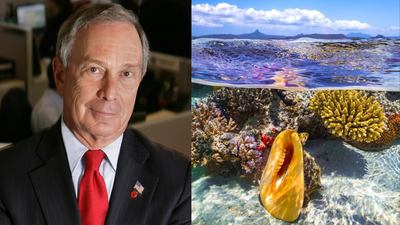
Bloomberg in Johns Hopkins University’s 1964 yearbook (Image: Wikipedia)
High Seas Treaty opens new chapter for ocean conservation
One of the most important developments behind the new investment is the High Seas Treaty, which entered into force in 2026. The agreement provides a legal framework for creating marine protected areas in international waters, an enormous part of the ocean that has historically lacked comparable mechanisms for comprehensive conservation. WHOI reported that Bloomberg Philanthropies will help partners establish the first marine protected areas created under the treaty. The organisation says this could eventually open the way for large-scale protections across nearly two-thirds of the ocean. Bloomberg Philanthropies’ annual report similarly identifies the treaty as a major milestone and says its partners are now working towards the first wave of protected areas in international waters. The challenge now is turning the treaty into functioning conservation systems, backed by scientific research, monitoring, governance and long-term enforcement.
AI, satellite monitoring and coral restoration will shape the next phase
The next stage of the Bloomberg Ocean Initiative will combine conservation policy with technology and marine science. Bloomberg Philanthropies says it plans to expand satellite monitoring, artificial intelligence and public data platforms to improve transparency around activity at sea. Through its partnership with Global Fishing Watch, the initiative has already helped create an open-access map of industrial fishing activity using satellite imagery and AI, monitoring activity across more than 291 million square kilometres of ocean. Coral reefs are another priority. WHOI reports that the initiative will support restoration projects in reefs already identified as priorities for long-term protection, including experiments designed to address damage caused by marine heatwaves, pollution and severe storms. Together, these efforts point towards a conservation model that combines protected areas with better observation, enforcement and restoration.
[ad_2]
Source link