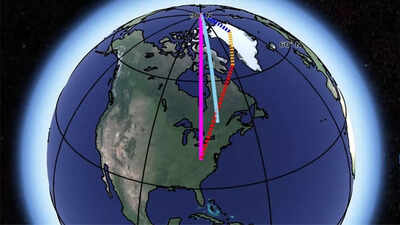
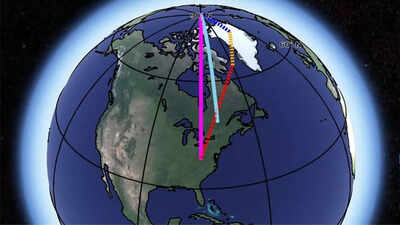
Looking out to the future, we see a gradual but also very important shift occurring right under our feet; the Earth’s own rhythm has begun to alter and slow down. New studies by researchers from both ETH Zurich and the University of Vienna have demonstrated that climate change caused by humans is making our planet’s rotation continuously longer than it has ever been at any time in recorded history for approximately 3.6 million years. As the polar ice caps have melted due to climate change, they have created a mass of water now distributed towards the equator, which resembles how an ice skater uses his arms to slow himself down as he turns. This has had a direct impact on slowing down how fast the Earth rotates. The current rate at which Earth is drastically slowing can be measured at approximately a very small but measurable slowdown of about 1.3 milliseconds per century. The study was published in the research article of the Journal of Geophysical Research: Solid Earth. The Solid Earth has established that anthropogenic causes this deceleration.
How melting ice is affecting Earth’s rotation
The Journal of Geophysical Research: Solid Earth publishes research by teams at ETH Zurich and the University of Vienna theorising that anthropogenic climate change plays a large role in changing the rotation of Earth. Melting glaciers from Greenland and Antarctica produce increased amounts of water that move into the ocean due to increasing average global temperatures.This redistribution of mass will change the way that weight is distributed across the Earth, which causes the Earth to rotate more slowly, which causes a slight increase in the amount of time it takes to complete one rotation (length of a day). Historically, other factors such as tidal forces from the Moon have been the main influences on this phenomenon. Currently, however, the brake placed on the Earth’s rotational speed caused by the melting of anthropogenic ice has become the principal influence.“In our earlier work, we showed that the accelerated melting of polar ice sheets and mountain glaciers in the 21st century is raising sea levels, which slows Earth’s rotation and therefore lengthens the day – similar to a figure skater who spins more slowly once they stretch their arms, and more rapidly once they keep their hands close to their body,” explains Mostafa Kiani Shahvandi of the University of Vienna’s Department of Meteorology and Geophysics. “What remained unclear was whether there were earlier periods when climate increased day length at a similarly rapid pace.”
The ‘figure skater effect’: A simple physics explanation
The principles of Angular Momentum provide a basis for how a slowing down occurs as a result of distance from the axis of rotation. Mass that travels away from this axis creates a slowing of its rotation.Figure skating is an example of this idea being tested. A figure skater who extends her arms will cause a decrease in the rate of spin, while bringing them in will create a faster spin. Movement of melting glacial ice, for example, redistributes water from the poles to the equator, which increases Earth’s Moment of Inertia and causes Earth to rotate slightly slower and increases the length of the day.
Measuring a tiny but important change
The impact on Earth’s rotation is negligible but still discernible; it is predicted that a day will last approximately 1.33 milliseconds longer each century as a result of fluctuations in the distribution of mass on the planet as a result of climate change.According to this research, human-induced melting of ice is one of the major contributors to this variation. The variation of a planet’s spin due to natural geophysical processes can typically be between 30 milliseconds and 2 minutes across an extended time period that can take many thousands of years. The amount of variation measured in the 21st-century is shocking by comparison.
What geological records reveal
Scientists utilise geological information to establish the relationship between changes happening today and those that occurred in the past. One key area where this type of data can be found is Benthic Foraminifera, which are minute marine creatures that build hard outer shells, called tests, made out of calcium carbonate (CaCO3) when living. The tests of Benthic Foraminifera provide us with a ‘chemical scrap book’ with which to examine past ocean conditions.By measuring the ratio of oxygen and carbon isotopes found in analysed tests, Mostafa Kiani Shahvandi and Benedikt Soja were able to analyse the fluctuations in sea levels for the past 3.6 million years back to the end of the Pliocene Epoch. These sea-level records have shown that while all natural phenomena have caused the Earth to rotate at different rates, primarily due to the ice ages, the current amount of time spent rotating is much faster than any of the changes that have occurred naturally over the past 3.6 million years. The only time that has occurred before was approximately 2 million years ago, and therefore it can be concluded that the period from 2000 to 2026 consists of a true ‘geological anomaly.‘
Combining modern data with advanced models
With the goal to unite ancient observations with modern data gathered by satellite analysis, a team of researchers has implemented an innovative artificial intelligence tool known as the Physics-Informed Diffusion Model (PIDM). The Physics-Informed Diffusion Model can anchor itself to existing principles of Physics rather than merely identifying numeric patterns, as traditional AIs would do.For example, the PIDM was programmed against the Sea Level Equation, which predicts oceanic evolution based on the following principles: gravitational force, centrifugal force due to Earth’s rotation, and the natural recovery of land caused by glacial retreat. To achieve this goal, the PIDM utilised Monte Carlo sampling techniques to develop records of 3.6 million years’ worth of Earth’s Ecological influences (with the aid of over 50,000 Monte Carlo samples) while removing extraneous sources of ‘noise’ (i.e., Moon feature terrestrial connectivity; and core material displacement) to isolate the magnitude of human underpinnings due to melting glacial ice.
Why this slowdown matters
The change in the Earth’s rotational rate may seem minuscule to notice in an everyday sense, but it is important in the world of science, especially when considering precise measures of time (e.g., short-term uses of time). In this regard, global time synchronisation must take into account very small changes in rotation between two consecutive days.To provide time with extreme accuracy, such as an Atomic Clock does, will need resynchronisation periodically (depending on how often the Earth’s rotation changes) to maintain alignment between the Atomic Clock and the rotational position of the Earth. If able to provide extreme accuracy of clocks used in GPS Navigation, Space Exploration Missions, and World Financial Systems without realignment/updates, it would create substantial issues with the precision of synchronisation between any such systems.
A subtle signal of a changing planet
The deceleration of the planet’s rotation illustrates how all of the systems on Earth are interrelated and interconnected; therefore, the changes that occur due to climate change, such as the melting of ice caps and the shifting of oceans, will not only have an impact on ecosystems and weather systems but also affect the basic principles of the planet itself.Although this time frame is measured in milliseconds, it is a measurable indication of the impact of human activities on Earth in complex and extensive ways. By 2100, the effects of climate change are likely to create changes to the length of a day that exceed that of the Moon’s effects- a change to the rhythm of the Earth that has not been experienced for millions of years.