[ad_1]
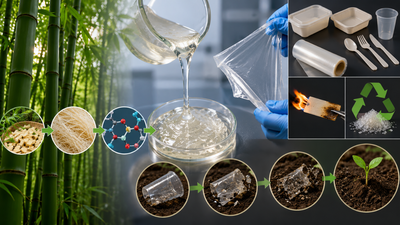
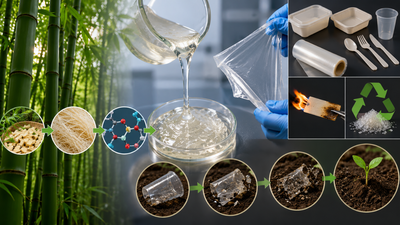
Plastic alternatives made from renewable materials often struggle to match the strength, heat resistance and processing ability of conventional plastics. A new bamboo-based bioplastic takes a different approach, reorganising cellulose at the molecular level to produce a material that is both strong and easier to shape. The researchers used a hydrated zinc chloride and formic acid deep eutectic solvent to break apart the hydrogen-bond network in bamboo cellulose, followed by calcium chloride and ethanol treatments that create a denser molecular structure.According to the study published in Nature, titled ‘High-strength, multi-mode processable bamboo molecular bioplastic enabled by solvent-shaping regulation’, the resulting bamboo molecular plastic reached a tensile strength of about 110 MPa and a flexural modulus of 6.41 GPa, while remaining stable across temperatures from −30°C to 100°C and showing resistance at 180°C. It could be moulded into complex and larger structures, recycled while retaining about 90% of its mechanical strength, and completely biodegraded in soil within 50 days under the study conditions. A techno-economic analysis estimated its production cost at about $2,302 per tonne, with raw materials and solvent recovery among the main cost factors.
How Chinese researchers transformed bamboo cellulose into biodegradable bioplastic
The researchers started with cellulose extracted from bamboo rather than using the plant simply as a fibre filler. Native cellulose contains extensive hydrogen-bond networks that help give bamboo its strength, but these networks also restrict molecular movement and make the material harder to process into different shapes. Earlier bamboo-based plastics have therefore tended to face problems such as brittleness and limited mouldability.To change that structure, the team used a hydrated zinc chloride and formic acid deep eutectic solvent. The treatment breaks apart the existing hydrogen-bond network and produces a more uniform cellulose molecular system. Calcium chloride is then used to form a flexible bamboo molecular hydrogel before the material undergoes a further treatment with ethanol.
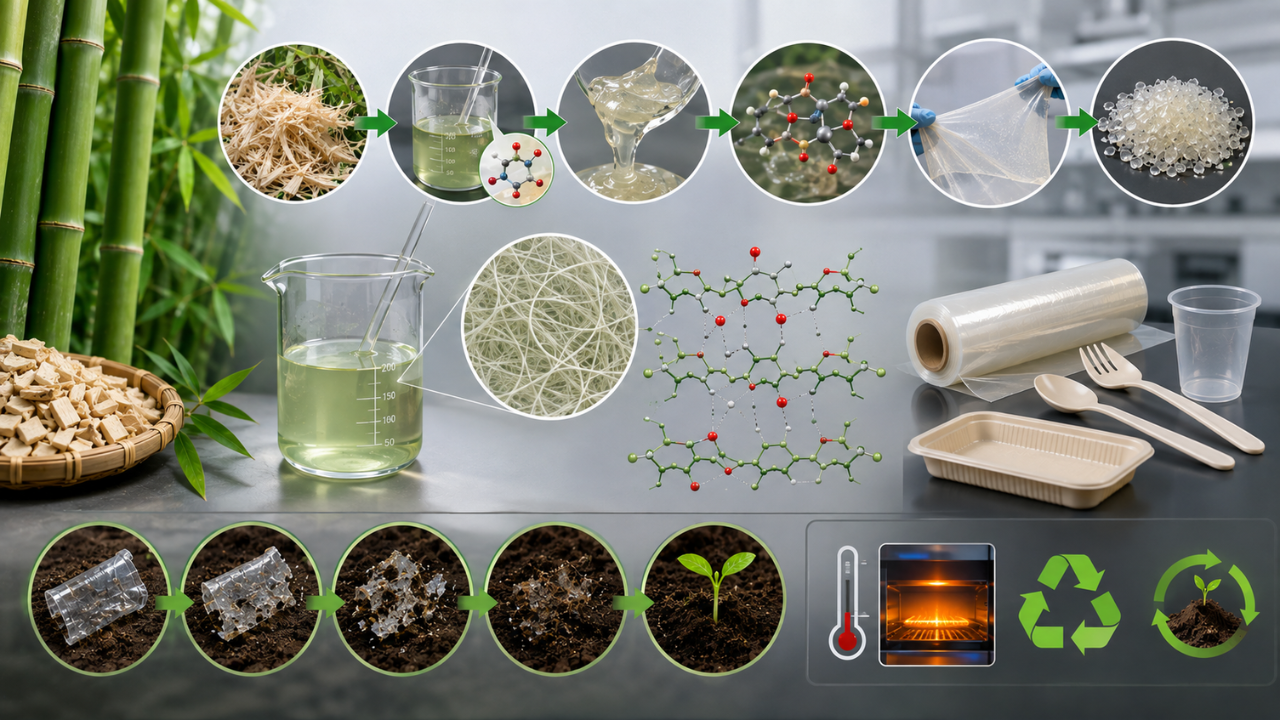
Image AI generated
Ethanol treatment gives China’s bamboo bioplastic 110 MPa tensile strength
The ethanol stage changes how the cellulose molecules are arranged. It encourages the chains to pack more closely and creates stronger interactions between them, producing a much denser structure. The resulting BM-plastic had a tensile strength of around 110 MPa, compared with about 9.7 MPa for the original hydrogel. Its flexural strength reached roughly 92 MPa, while its flexural modulus rose to 6.41 GPa.Microscopy showed a more compact structure with fewer pores after the treatment, while X-ray analysis indicated greater molecular ordering. The material also remained stable through a range of temperature and environmental tests. It retained its physical integrity between −30°C and 100°C, and tests at 180°C showed less deformation than several conventional plastics used for comparison.
China’s bamboo bioplastic can be moulded into complex 3D structures
The material’s strength was accompanied by the ability to be shaped. The researchers used moulding and related processing methods to produce different forms, including gears, shells and other three-dimensional structures. They also demonstrated larger structures, producing honeycomb and corrugated panels from a sheet measuring 50 cm by 35 cm.The process does not require high temperatures or pressures for the main shaping stage. That could make the approach relevant to manufacturing processes where energy use is an important consideration. In thin samples, BM-plastic also showed high light transmission, with a measured transmittance of 90.32% at a thickness of about 0.15 mm.
Chinese researchers develop recyclable bamboo bioplastic with 90% strength retention
The researchers designed the material to be processed again rather than treated as a single-use product. Used BM-plastic can be dissolved back into a bamboo cellulose molecular system using recycled deep eutectic solvent, after which the calcium chloride and ethanol stages can be repeated to produce new material.The recycled BM-plastic recorded a tensile strength of 97 MPa and an elastic modulus of 2.7 GPa. The study reports that around 90% of the original mechanical strength was retained after reprocessing.
China’s bamboo bioplastic biodegrades completely in soil within 50 days
The material was also tested for what happens after it can no longer be recycled. Samples were buried in natural soil at 25°C and monitored over time. Within 50 days, the BM-plastic had completely disintegrated morphologically and undergone biodegradation, with microbial activity contributing to the process. The conventional plastics tested alongside it showed negligible degradation over the same period, while PLA and PBAT degraded only partially.The 50-day result comes from the specific soil conditions used in the experiment and should not be treated as a fixed degradation time for every product or environment. Temperature, moisture, microbial activity and material characteristics can all affect how quickly biodegradable materials break down.
China’s bamboo bioplastic could cost $2,302 per tonne to produce
The researchers also carried out a techno-economic analysis, estimating the production cost of BM-plastic at about $2,302 per tonne. Raw materials were the largest cost component, while the recovery and reuse of the deep eutectic solvent and ethanol also accounted for significant shares. Electricity made up 3.32% of the estimated production cost. The work forms part of a wider interest in bamboo-derived materials. As per the United Nations Development Programme, China has highlighted bamboo nanocellulose projects aimed at replacing some conventional plastic products in packaging and agriculture. The new BM-plastic takes a different route, focusing on the molecular organisation of cellulose to produce a material that combines strength, mouldability, recycling and biodegradation.The researchers report that the material can withstand temperatures above 180°C, has a tensile strength exceeding 100 MPa and a flexural modulus above 6 GPa. Whether those properties can be maintained consistently during large-scale production will depend on factors such as solvent recovery, raw-material supply and manufacturing costs. For now, the results provide a laboratory demonstration of how bamboo cellulose can be reorganised into a stronger and more processable form of bioplastic.
[ad_2]
Source link