[ad_1]
Human beings are driven by a complicated mix of thoughts, desires and emotions. We can reason through difficult problems, become passionate about something we love and still experience impulses that are difficult to explain. More than two thousand years ago, the Greek philosopher Pythagoras reflected on this complexity through his idea that the human soul consists of different elements. He wrote, “The soul of man is divided into three parts, intelligence, reason, and passion. Intelligence and passion are possessed by other animals, but reason by man alone.” His words invite us to consider what separates human thought from instinct and how different parts of our nature influence the choices we make.Pythagoras (c. 570-495 BCE) was an ancient Greek philosopher and mathematician, best known for the mathematical theorem associated with his name. He also founded a philosophical school whose teachings explored mathematics, ethics, the nature of reality and the human soul.
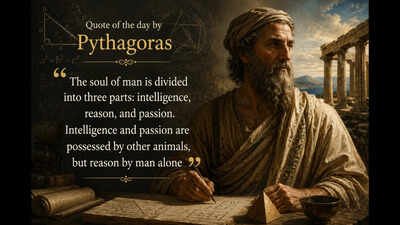
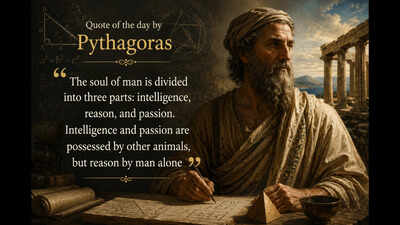
Quote of the day by Pythagoras
“The soul of man is divided into three parts, intelligence, reason, and passion. Intelligence and passion are possessed by other animals, but reason by man alone”
What does this quote mean
Pythagoras was arguing that there are several things that influence our behaviour. Our intelligence enables us to comprehend what is happening around us, and our passions provide us with desire. On the other hand, reason makes it possible for us to think and make a decision on which direction we should go. It is his main point that man has the ability to stop himself and think.
Intelligence gives us the ability to understand
Intelligence enables us to learn from our experiences and identify patterns. With intelligence, we are able to cope in changing situations and understand the world around us. However, intelligence is not synonymous with wisdom. The individual may know exactly what the consequences of his actions will be and yet act contrary to his knowledge because there is something else, like emotion, which takes precedence over wisdom.
Passion gives life its energy
While passion is considered something that needs to be harnessed, it is also an impulse that inspires one to move forward and achieve. Artistic creation is motivated by deep passion for what is being created, scientific inquiry is fueled by the quest to solve intriguing questions, and sportsmen undergo strenuous exercises in order to achieve their goals because of passion. Passion fuels ambition. Without passion, intellect and logic would exist only in theory.
Reason creates space between impulse and action
The most distinctive part of Pythagoras’ argument is his emphasis on reason. Human beings can experience anger, fear, excitement or desire without necessarily acting on the first impulse those emotions produce. We can pause, consider consequences and choose a different response. That small space between feeling something and acting upon it is one of the foundations of judgement and self-control.
A balanced mind needs more than one quality
Without judgement, intelligence might be misused, and without control, passion might turn into destructiveness. On the other hand, reason without enthusiasm may not be able to incite action. Therefore, these three virtues can be said to complement each other. Knowledge provides direction, passion provides motivation, and reason provides us with the means to use both.
The struggle between thought and desire is universal
Even the most disciplined person experiences moments when what they want conflicts with what they know they should do. We might want to stay in bed despite knowing we have work to finish, spend money despite knowing we should save it or react angrily despite knowing that silence would be wiser. These everyday conflicts show why self-awareness matters. Knowing what influences our decisions can make it easier to choose deliberately rather than simply react.
Why this quote still matters today
Over two thousand years after his statement was made, one cannot help but wonder whether Pythagoras was addressing a very fundamental aspect of humanity: how does one make decisions? Intelligence, emotion and desire have their roles to play, but reason allows one to put these things in perspective. The message in his statement, which has remained true throughout time, is that being human means not only thinking and feeling, but questioning one’s thoughts and feelings.
[ad_2]
Source link