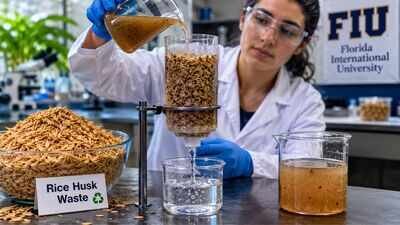
florida scientists are turning rice husk waste into reusable water filters that can remove pollutant

Florida scientists are turning rice husk waste into reusable water filters that can remove pollutants from contaminated water |

[ad_1] Rice leaves behind more than a meal. After the grain has been processed, the tough outer husk is usually treated as an unwanted agricultural residue, with enormous quantities accumulating every year. Much of it has little obvious use and can become an environmental burden when it is burned or dumped. At Florida International University,…

Read More
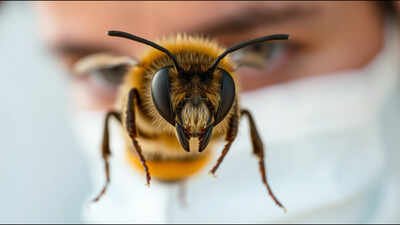
scientists trained honeybees to recognise human faces showing how tiny brains can distinguish faces

Scientists trained honeybees to recognise human faces, showing how tiny brains can distinguish faces by the arrangement of their features |

[ad_1] Honeybees can be trained with nothing more than the promise of a sugary reward; they learn to pick out a specific face and keep picking it out later, even when it appears from a slightly different angle or sits among faces they have never encountered before. It is a strange and slightly humbling discovery,…

Read More

In 2013, honeybees were trained to find land mines left behind by the Balkan wars, turning their extraordinary sense of smell into an unlikely detection tool |

[ad_1] Croatia was still dealing with the hidden legacy of the Balkan wars when scientists began looking to an unlikely ally: honeybees. Years after mines had been buried across fields, forests and rural land, uncertainty over their locations continued to complicate farming, development and everyday life. Traditional mine-clearance teams faced the difficult task of finding…

Read More
133087453

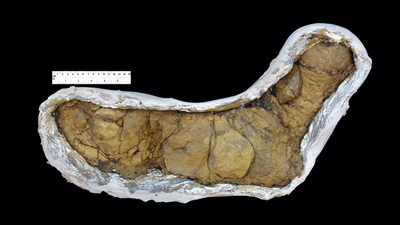
Scientists discovered that animal poop travelled across oceans 540-million-years ago and triggered the evolution of life on earth |

[ad_1] A large coprolite of a carnivorous dinosaur found in Harding County, South Dakota, US. Image Credit: Poozeum/Wikipedia Around 540 million years ago, the biological landscape of Earth went through a huge transformation called the Cambrian explosion. During this era, the ancestors of most modern animal groups began to appear, depicting a massive surge in…

Read More
the discovery may also help explain why conventional traps and insecticidal baits can sometimes have

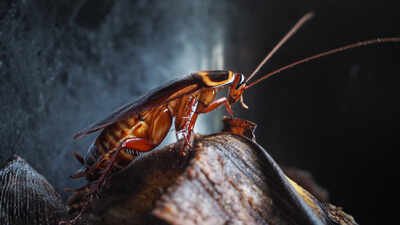
Newborn German cockroaches eat from a shared fecal pile and learn their colony’s smell; the social bond may explain why traps often fail

[ad_1] The discovery may also help explain why conventional traps and insecticidal baits can sometimes have trouble controlling infestations. why cockroach traps fail, how German cockroaches find their colony, how cockroach pheromones work, why cockroaches gather in groups, newborn cockroaches learn colony smell, cockroach feces used to identify colony members, using pheromones to control cockroach…

Read More
meet sirish subash the 14 year old who invented an ai powered pesticide detector for fruits and vege

Meet Sirish Subash: The 14-year-old who invented an AI-powered pesticide detector for fruits and vegetables and won $25,000 |

[ad_1] A 14-year-old Georgia student has turned a common kitchen concern into an award-winning science project. Sirish Subash, a ninth grader from Snellville, built PestiSCAND, a handheld device designed to detect pesticide residues on fruits and vegetables. As reported by USA Today, his invention earned him the title of America’s Top Young Scientist in October…

Read More
1786297557 unnamed file

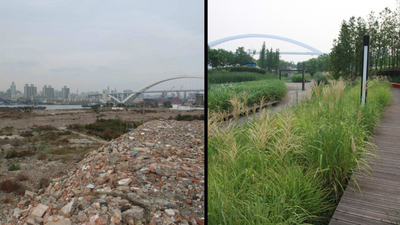
In 2010, Shanghai turned a polluted industrial brownfield into Houtan Park; its wetlands now clean up to 634,000 gallons of river water a day

[ad_1] A similar vantage point pre-park construction and a similar vantage point post-park construction (Source: Kongjian Yu) In 2010, Shanghai transformed a polluted industrial brownfield into Houtan Park. Its wetlands now clean up to 634,000 gallons of river water each day. The 14-hectare linear park stretches along the Huangpu River and was once home to…

Read More
redonda had become a thriving haven for wildlife within a few years and now it has received a major

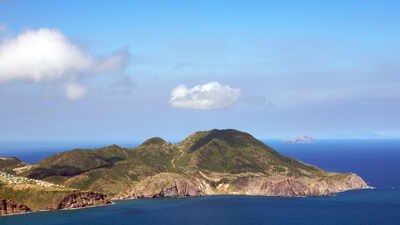
In 2017, Antigua and Barbuda removed invasive rats and goats from Redonda; by 2023, vegetation biomass rose over 2,000% and ground dragons increased 13-fold

[ad_1] Redonda had become a thriving haven for wildlife within a few years, and now it has received a major new layer of protection. For years, Redonda resembled more a barren moonscape than a tropical Caribbean island. Its vegetation was destroyed, its native wildlife was wiped out, and the marine ecosystem around it was harmed…

Read More