[ad_1]
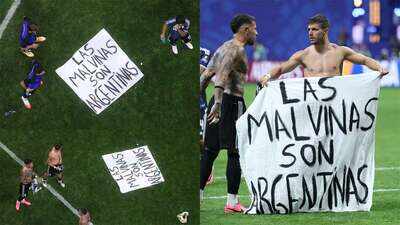
NEW DELHI: Argentina’s dramatic 2-1 comeback win over England in the FIFA World Cup 2026 semifinal was followed by a fresh controversy. After the final whistle at the Mercedes-Benz Stadium in Atlanta, Argentina midfielder Giovani Lo Celso celebrated with a banner that read “Las Malvinas son Argentinas” – a slogan linked to Argentina’s claim over the Falkland Islands.According to The Athletic, the display could invite FIFA disciplinary action because football’s governing body prohibits political messages during matches. Here’s everything you need to know about the controversy:
What does ‘Las Malvinas son Argentinas’ mean?
“Las Malvinas son Argentinas” translates to “The Malvinas are Argentine.” ‘Las Malvinas’ is the name Argentina uses for the Falkland Islands, a British overseas territory located around 300 miles (480 km) off Argentina’s east coast.Following Argentina’s semifinal win, Lo Celso held the banner alongside defender Nicolas Otamendi. The banner appeared to have first been displayed by supporters in the stands. The pair briefly held it up before putting it away, after which Lo Celso laid it on the pitch during the celebrations.
Why are the Falkland Islands disputed?
The Falkland Islands have been at the centre of a sovereignty dispute between Argentina and the United Kingdom for more than 190 years.The dispute dates back to the early 19th century during the Napoleonic Wars. Britain first claimed the islands in 1774 and re-established control in 1832.In 1982, Argentina’s military government invaded the islands in an attempt to take control, triggering the Falklands War.The conflict lasted from April 2 to June 14 before ending with Argentina’s surrender. Three civilians, 255 British servicemen and 649 Argentine troops were killed during the war.
What did Argentina’s Foreign Ministry say?
Days before the World Cup semifinal, Argentina’s Ministry of Foreign Affairs issued an official communiqué reaffirming the country’s claim over the islands.The statement was titled:OFFICIAL COMMUNIQUÉMALVINAS ISSUE: THE ARGENTINE REPUBLIC PROTESTS TO THE UNITED KINGDOM OVER THE CARRYING OUT OF UNNOTIFIED MOVEMENTS OF HMS MEDWAY TOWARDS THE ARGENTINE CONTINENTAL COASTBy instruction of Foreign Minister Quirno, on July 13 a formal note of protest was submitted to the Embassy of the United Kingdom of Great Britain and Northern Ireland, expressing the strongest rejection of the movements of the HMS Medway, illegally stationed in the Malvinas Islands, which were not duly notified in accordance with the bilateral agreements and declarations in force, and which involved transit through the Argentine Territorial Sea.This unilateral action constitutes a violation of the commitments assumed by both Governments in the Joint Declaration of September 25, 1991, which replaces its annexes I, II, III and IV, and in the Joint Declaration signed in Madrid on February 15, 1990, in its section I.2 “Measures to strengthen mutual confidence,” point “b” (text according to the Joint Declaration signed in Buenos Aires and London on July 12, 1993).The Argentine Government firmly rejects this British military incursion into areas under Argentine jurisdiction, which is added to a sustained policy of unilateral acts incompatible with United Nations resolutions and with the duty of both parties to refrain from altering the situation while the sovereignty dispute remains pending resolution.Such unnotified and illegal movements contravene the bilateral commitments on confidence-building measures in the military sphere in force between the two countries, while adding to the long series of unilateral actions that the United Kingdom of Great Britain and Northern Ireland has carried out in contravention of United Nations General Assembly Resolution 31/49, which urges both parties to refrain from adopting decisions that entail the introduction of unilateral modifications to the situation of the Malvinas Islands while the sovereignty dispute remains pending resolution.Far from creating the conditions of trust and understanding required for a mature bilateral relationship, these actions deepen tensions in the South Atlantic, disregard the repeated mandate of the international community, and hinder Argentine efforts to advance towards a peaceful and negotiated solution to the dispute.The Argentine Republic reaffirms, once again, its legitimate and imprescriptible sovereign rights over the Malvinas Islands, South Georgia, the South Sandwich Islands, and the surrounding maritime areas.By history, by right, and by conviction, the Malvinas are Argentine.MINISTRY OF FOREIGN AFFAIRS
Why could FIFA take action?
The International Football Association Board (IFAB) and FIFA prohibit political slogans, symbols and messages during matches.IFAB’s Laws of the Game state: “Equipment must not have any political, religious or personal slogans, statements or images. Players must not reveal undergarments that show political, religious, personal slogans, statements or images, or advertising other than the manufacturer’s logo.”It further adds: “For any offence the player and/or the team will be sanctioned by the competition organiser, national football association or by FIFA.”If FIFA considers the “Las Malvinas son Argentinas” banner to be political, Argentina could also be found in breach of the governing body’s stadium code of conduct.FIFA’s list of prohibited items includes: “Any materials, including but not limited to banners, flags, fliers, apparel and other paraphernalia, that are of a political, offensive and/or discriminatory nature, containing wording, symbols or any other attributes aimed at discrimination of any kind against a country, private person or group on account of race, skin colour, ethnicity, national or social origin, gender identity and expression, disability, language, religion, political opinion or any other opinion, birth, wealth or any other status, sexual orientation or on any other grounds.“
[ad_2]
Source link