
[ad_1]

In 1937, Australian scientists took an unusual step in the fight against one of the country’s most destructive pests known as ‘rabbits.’ They released rabbits carrying ‘myxoma virus’ on Wardang Island, off South Australia, to see whether the disease could spread naturally. The experiment was part of a much longer effort to find a biological way of controlling Australia’s enormous European rabbit population. Rabbits had multiplied rapidly after being introduced in the 19th century, competing with livestock for food and damaging native vegetation. Earlier laboratory work had suggested that myxomatosis could kill rabbits, but attempts to make it spread between wild populations had been disappointing. The Wardang Island trials therefore became an important test of whether the virus could work outside the laboratory. More than a decade later, a much larger release produced a dramatic decline in rabbit numbers across Australia.
Why rabbits became such a serious problem in Australia
European rabbits had been introduced to Australia in 1859 by Thomas Austin, a wealthy Victorian grazier who wanted animals for sporting purposes. According to CSIROpedia, the rabbits soon multiplied at an extraordinary rate. Their numbers grew into the millions, creating serious competition with livestock and contributing to environmental damage. Traditional methods of controlling the animals were proving inadequate. Scientists and agricultural authorities therefore began looking for something that could spread through rabbit populations without requiring people to kill the animals one by one. One possibility was myxomatosis, a disease caused by the myxoma virus. ScienceDirect explains that the virus naturally affects certain South American rabbits, in which it generally causes relatively mild skin tumours. European rabbits, however, are far more vulnerable and can develop a severe, often fatal disease.

European rabbits in Australia 2004. Image Credit: CSIRO/Wikipedia
First testing of myxomatosis in a lab-controlled environment
The idea was not entirely new. CSIROpedia notes that Brazilian virologist ‘Aragao’ had suggested in 1919 that myxomatosis might be useful for controlling rabbits in Australia. Laboratory experiments were carried out in New South Wales in 1926, but the results were not encouraging enough to justify wider use. Interest returned in the 1930s, particularly through the efforts of ‘Dame Jean MacNamara.’ CSIRO arranged for ‘Sir Charles Martin’ to conduct laboratory tests in England, followed by further Australian experiments led by ‘Dr Lionel Bull’ of the CSIRO Division of Animal Health in 1936. Those tests indicated that the virus did not pose a threat to domestic stock or native animals, allowing Bull to begin field trials.The early field trials were frustrating. In arid South Australia, scientists could kill rabbits in individual warrens where infected animals had been introduced, but the infection failed to move effectively from one warren to another. That limitation was crucial. A disease that could not travel through rabbit populations naturally would have little value as a large-scale control method.
Releasing infected rabbits on the Wardang Island
The scientists turned to Wardang Island to test the idea under field conditions. According to CSIROpedia, Lionel Bull released the first infected rabbits on Wardang Island on 16 November 1937. The experiment was intended to examine whether myxomatosis could spread among rabbits in a more natural setting. The island experiment became an important chapter in Australia’s attempts to understand biological control, even though the early work did not immediately provide the answer scientists wanted.The problem was transmission. The virus needed a way to move from an infected rabbit to another rabbit, and insects could play an important role. ScienceDirect explains that myxoma virus can be transmitted by blood-feeding insects, including mosquitoes and fleas. These findings helped scientists understand why conditions in the field mattered so much. The presence of suitable insect vectors could determine whether an outbreak remained local or expanded.
Why did scientists return to the idea in 1949
By the end of the 1940s, the rabbit problem had become increasingly difficult to ignore. CSIROpedia records that traditional control methods were considered inadequate, while pressure for new approaches was growing. In late 1949, Francis Ratcliffe decided that further trials should be conducted to examine whether the limited ability of myxomatosis to spread could nevertheless be used effectively. This time, the circumstances were more favourable. Scientists had learned from earlier experiments, while the search for a practical biological control method had become more urgent. The following year, myxoma virus was released into Australia’s wild rabbit population.
Dramatic effect of myxomatosis on the Australian rabbits
The results were far more dramatic than the earlier trials had suggested. According to CSIROpedia, the initial release in 1950 caused a huge reduction in Australia’s rabbit population. Within two years, wool and meat production had recovered by an estimated $68 million as the pressure from rabbits declined. ScienceDirect reported that more than 99% of European rabbits died after infection with the original highly virulent virus. But the victory did not last.
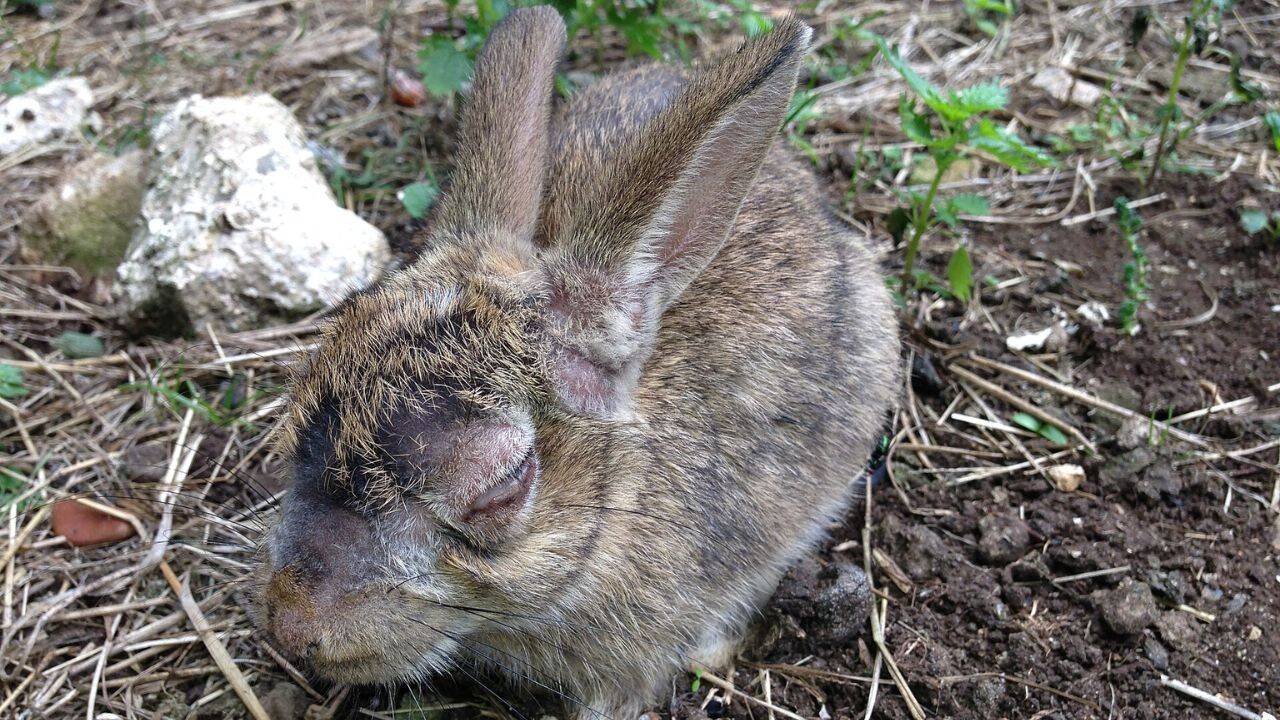
A rabbit displaying signs of myxomatosis. Image Credit: Wikipedia
How did rabbits and the virus adapt
The most fascinating part of the story came after the initial devastation. Scientists observed that both the virus and rabbit populations changed over time. ScienceDirect explains that less lethal strains of the virus gradually became more common because rabbits infected with them survived longer, giving the virus more opportunities to spread. At the same time, rabbits that were naturally more resistant were more likely to survive and reproduce. CSIROpedia similarly notes that the effectiveness of myxomatosis gradually declined as both the virus and rabbits changed genetically. The result was not the complete disappearance of rabbits, but a new balance between the animals and the disease.
Importance of the 1937 experiment
The Wardang Island experiment illustrates how scientists sometimes have to test an idea repeatedly before understanding why it works or why it fails. The infected rabbits released in 1937 did not immediately solve Australia’s rabbit problem. Instead, the trials helped reveal the practical difficulties of making a disease spread through wild rabbit populations. More than a decade later, those lessons formed part of the background to the successful 1950 release. The episode ultimately became one of the most striking examples of biological control, showing how a virus could dramatically alter the fortunes of an invasive species and how nature could eventually respond in ways scientists could not fully control.
[ad_2]
Source link