[ad_1]
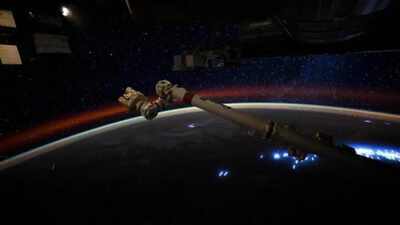
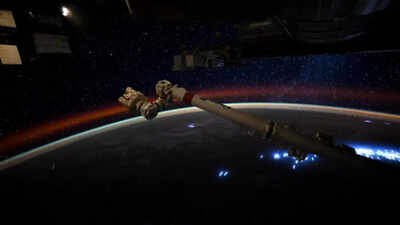
The night sky still holds many interesting elements for both scientists and people interested in astronomy in terms of phenomena that take place throughout the year. One recent update coming from an astronaut on the International Space Station operated by NASA draws attention to the ongoing activity of the Lyrid meteor shower. In this respect, photos taken by a NASA astronaut from the International Space Station depict several meteors appearing in the night sky before approaching Earth’s atmosphere. These photographs illustrate streaks of light seen in the night sky against the background of an illuminated Earth. It coincides with the maximum activity of the Lyrid meteor shower, which takes place on April 21 and 22 each year.
Lyrid Meteor Shower 2026: NASA astronaut reveals breathtaking view from space station
The phenomenon was recorded by Jessica Meir when she was serving aboard the International Space Station. The photograph was captured from the space station’s cupola, which is a module with windows specifically used for observing Earth and photography. From an orbital viewpoint, the observer can capture a wider and continuous view as opposed to ground-level observation.In taking the photo, a three-second exposure was applied. Such exposure made artificial lights from Earth look like streaks of light in the picture. On the other hand, a meteor looks like a streak of light that is situated beneath the horizon.
Understanding the Lyrid meteor shower
The Lyrids are an annual event that occurs because of Earth’s encounter with dust particles from a comet. The dust particles become heated due to friction as they enter Earth’s atmosphere; as a result, people can observe light shows in the sky.It is called the Lyrids because this type of meteor shower appears to originate from the Lyra constellation. This specific spot in the sky is referred to as the radiant. For the Northern Hemisphere, it is advised to observe the skies in the East. This kind of meteor shower has many meteors appearing in the sky within an hour.
Best conditions to watch the Lyrid meteor shower from Earth
The observation of the Lyrid meteor shower from Earth relies on certain environmental conditions. Good weather conditions and low light pollution levels will favor the visibility of the event. Observing the phenomenon in urban settings can hinder visibility due to lighting, whereas the visibility conditions can be favorable in rural areas. As opposed to ground observations, pictures taken from space are not subject to weather conditions like clouds. This way, visibility can improve in space as there will be fewer disturbances when meteors pass through the atmosphere.The time of occurrence is still significant. Most activities should occur between late night and early morning on April 21 and April 22.
Visibility of the space station
The astronaut also noted that observers on Earth may be able to see the International Space Station as it passes overhead. The station appears as a bright, steadily moving object in the night sky and is visible without the need for telescopic equipment. Its movement is smooth and continuous, distinguishing it from stars and aircraft. The visibility of the station depends on its orbital path and local viewing conditions.
Ongoing scientific interest in the Lyrid meteor shower
Nevertheless, meteor showers are still a topic of scientific research. The Lyrids can serve as a chance to analyse the interaction of the Earth’s atmosphere with space matter. Moreover, it helps further explore both atmospheric phenomena and space exploration. The photos from orbit serve as an additional view that confirms what people on the surface see. Even though the experience is not the same in different places, the phenomenon itself stays the same. The Lyrid meteor shower will last for some time before fading away. Thus, the sky needs to be observed during its most active period in order to increase the possibility of viewing meteors.
[ad_2]
Source link