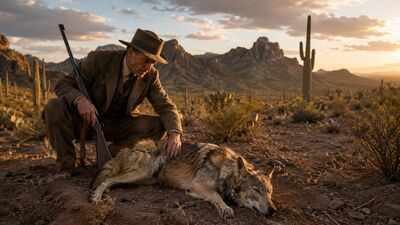
in the 1920s a yale trained forester shot a wolf in the arizona desert what he saw next changed cons

In the 1920s, a Yale-trained forester shot a wolf in the Arizona desert: What he saw next changed conservation forever |

[ad_1] In the early years of the 20th century, conservation in the United States was still taking shape as a profession rather than a philosophy. Forests were being mapped, species counted, land divided into managed zones with a confidence that nature could be organised if only enough data were gathered. Among the young men entering…


Read More
iisc researcher

IISc study finds ultrasound can selectively destroy oral cancer cells

[ad_1] IISc Researchers Rashmita Luha (left) and Ajay Tijore (right) | Credit: IISc BENGALURU: Researchers at the Indian Institute of Science (IISc) have found that low-frequency ultrasound can selectively kill oral cancer cells while leaving healthy cells largely unharmed, raising the possibility of a less invasive treatment for one of India’s most common cancers.Oral cancer…

Read More
an artist39s impression of the tunguska airburst over central siberia on 30 june 1908

80 million trees were wiped out in seconds in Siberia after a space rock explosion more powerful than the Hiroshima bomb, but scientists never found a crater |

[ad_1] An artist’s impression of the Tunguska airburst over central Siberia on 30 June 1908. An explosion powerful enough to destroy millions of trees should have left behind a giant crater. Instead, when scientists finally reached the remote Siberian wilderness where the blast had occurred, they found only a forest laid out like matchsticks. There…

Read More
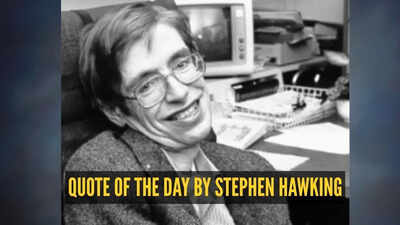
quote of the day by stephen hawking

Quote of the day by Stephen Hawking: “I have lived with the prospect of an early death for the last 49 years. I’m not afraid of death, but I’m in no hurry to die” – the secret to living fully despite uncertainty |

[ad_1] Quote of the day by Stephen Hawking (Image Credit: Wikipedia) Today’s quote of the day comes from Stephen Hawking, the theoretical physicist who spent more than five decades living with a diagnosis that was originally expected to kill him within two years. He said, “I have lived with the prospect of an early death…

Read More
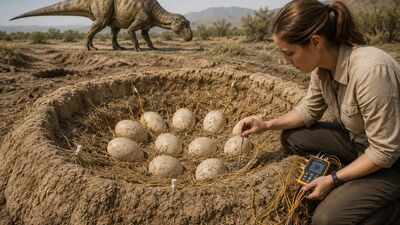
scientists recreated a dinosaur nest to uncover how eggs stayed warm 70 million years ago

Scientists recreated a dinosaur nest to uncover how eggs stayed warm 70 million years ago |

[ad_1] For decades, palaeontologists have puzzled over a scene preserved in rock across parts of Mongolia and China. Fossilised oviraptor dinosaurs were repeatedly found sitting over nests in a posture that looked strikingly familiar. Their forelimbs spread across the clutch, their bodies positioned above the eggs, almost as if they were brooding like modern birds.The…

Read More
brown tree snakes reached guam hidden in military cargo during world war ii and it triggered an ecol

Brown tree snakes reached Guam hidden in military cargo during World War II, and it triggered an ecological collapse that wiped out nearly all native birds and slashed tree seedling growth by up to 92% |

[ad_1] An invasive snake that likely arrived on Guam hidden inside military cargo after the Second World War went on to transform the island’s ecosystem in ways scientists are still trying to understand. The brown tree snake, native to parts of Australia, Papua New Guinea and nearby islands, found an environment unlike any it had…

Read More
quote of the day by marie curie ai generated image

Quote of the day by Marie Curie: “One never notices what has been done; one can only see what remains to be done” – a timeless lesson about ambition, progress and gratitude |

[ad_1] Quote of the day by Marie Curie (AI-generated image) Today’s quote of the day comes from Marie Curie, the physicist and chemist who remains the only person ever to win a Nobel Prize in two different sciences. She wrote, “One never notices what has been done; one can only see what remains to be…

Read More