[ad_1]
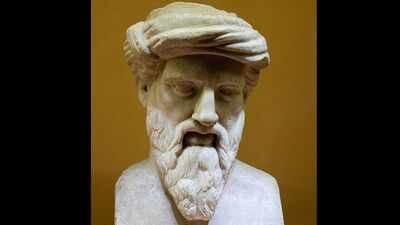
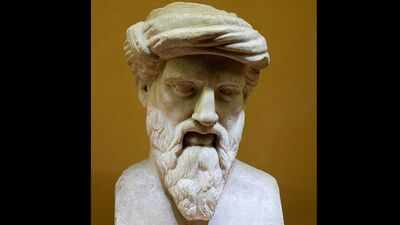
Humans depend entirely on the natural world, and yet the relationship has always been tangled with contradiction, admiration for animals sitting right alongside routine cruelty toward them. A line attributed to Pythagoras names that contradiction directly. “As long as Man continues to be the ruthless destroyer of lower living beings, he will never know health or peace,” the fuller version continues. “For as long as men massacre animals, they will kill each other. Indeed, he who sows the seed of murder and pain cannot reap joy and love.” The claim is not simply about animal welfare on its own terms. It is a statement about what a society becomes once it grows comfortable with unnecessary cruelty, and what that comfort eventually costs it elsewhere.
Quote of the day by Pythagoras
“As long as Man continues to be the ruthless destroyer of lower living beings, he will never know health or peace”
Where this quote actually comes from
Pythagoras left no writings of his own, so everything attributed to him survives only through later sources. This particular line comes through the Roman poet Ovid, in Metamorphoses, written roughly five centuries after Pythagoras lived, in a section giving Pythagoras an extended speech on vegetarianism and the kinship of all living things. It was later collected in Jon Wynne-Tyson’s 1985 book The Extended Circle: A Dictionary of Humane Thought.That chain of transmission matters, but it is not evidence of fabrication. Pythagoras is genuinely and consistently associated with avoiding meat and believing in the kinship between humans and animals, a belief tied to his teaching on metempsychosis, the idea that souls transmigrate between bodies after death, meaning the animal on your plate might, in his framework, once have carried a human soul.
What the quote is actually arguing
The claim links two things not usually placed side by side, cruelty toward animals and humanity’s own capacity for peace. Pythagoras is arguing that violence does not stay contained to its original target. A society comfortable inflicting suffering on the vulnerable becomes, in his view, a society that has already made peace with violence generally, which then shows up in how people treat each other as well.
Why cruelty rarely stays isolated
Widespread indifference to suffering tends to dull sensitivity to suffering generally, not just toward the specific beings it was originally aimed at. This does not mean every act of harm towards an animal leads directly to harm toward people. It means normalised cruelty in one direction tends to weaken compassion more broadly, which is really the ethical concern sitting underneath the quote.
Why health, in this reading, reaches beyond the individual
Modern understanding of health includes far more than the personal absence of disease, extending to clean water, stable ecosystems and the wider environment that sustains human life. Read that way, the quote gains a distinctly modern edge, since damage to the natural world rarely stays contained to the natural world alone.
Other famous quotes attributed to Pythagoras
- “The oldest, shortest words, ‘yes’ and ‘no’, are those which require the most thought.”
- “As soon as laws are necessary for men, they are no longer fit for freedom.”
- “There is geometry in the humming of the strings, there is music in the spacing of the spheres.”
- “No man is free who cannot control himself.”
Why this quote continues to inspire generations
The question of what humans owe to other forms of life remains genuinely unresolved, debated across animal welfare, environmental policy and everyday choices about consumption. Pythagoras’ line, whatever its exact path to us, still poses the same direct challenge it always did, whether real peace can exist alongside routine, unnecessary cruelty, or whether the two were only ever going to undermine each other.
[ad_2]
Source link