[ad_1]
Coffee is brewed billions of times every year, leaving behind mountains of damp grounds that are usually treated as little more than rubbish. Some find a second life in compost or gardening, but the overwhelming share is either burned or buried despite still containing a considerable amount of stored energy. The problem has never really been the material itself. Freshly discarded coffee grounds hold so much moisture that converting them into a practical fuel normally requires lengthy drying or other energy-intensive preparation. A research team in South Korea has now demonstrated a different approach. Rather than removing the water first, they have shown that the moisture can become part of the conversion process itself, producing a charcoal-like fuel in little more than a minute.
Scientists turn coffee grounds’ moisture from a problem into an advantage
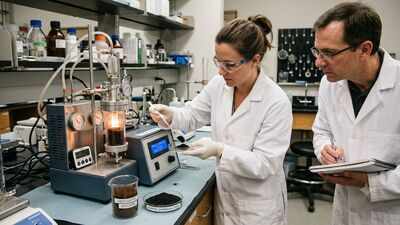
Used coffee grounds have attracted interest for years because they contain valuable organic compounds and retain a relatively high energy content after brewing. Yet their water content has remained a persistent obstacle.The traditional way includes drying up the waste material before it is processed into fuel or oil extraction using some further procedures. The above processes take time and effort, thus making mass recycling unattractive in many cases.The study published in Chemical Engineering Journal, titled, ‘Rapid conversion of wet spent coffee grounds into high-calorific biochar via drying-free flame plasma pyrolysis for process intensification’, suggests that the researchers from the Korea Institute of Geoscience and Mineral Resources (KIGAM) have chosen a completely different approach to the problem. Instead of seeing water content as an obstacle which should be eliminated first, they have created a system that utilizes it in the process of conversion.
A 900°C plasma flame transforms wet coffee grounds in 90 seconds
The technique relies on flame plasma pyrolysis, a process that exposes wet coffee grounds to extremely high temperatures generated by a plasma flame. The flame is produced using liquefied petroleum gas together with compressed air, creating conditions that reach roughly 900°C.Inside the system, the trapped water heats almost instantly. As it rapidly changes into steam, pressure builds throughout the coffee particles before being released through countless microscopic bursts. Those tiny internal explosions help break apart the structure of the material while driving off moisture at remarkable speed.The entire treatment takes only around 90 seconds from start to finish.
The process turns coffee waste into energy-rich biochar
Once processing is complete, what remains bears little resemblance to the original coffee waste. The grounds lose more than four-fifths of their original mass as water escapes, leaving behind a dry, lightweight and highly porous biochar. Its structure makes it suitable as a solid fuel, while the conversion also increases the amount of usable energy stored within the material.According to the research team, the finished biochar delivers a heating value of about 29 megajoules per kilogram. That places it in the same general range as conventional coal and charcoal used for fuel applications. The process also raises the calorific value of the original coffee waste by roughly one-third, making better use of material that would otherwise have been discarded.
Most of the world’s coffee waste is still discarded
Coffee consumption continues to rise worldwide, bringing an equally large increase in spent grounds. Each year, almost 10 million tonnes of used coffee grounds are generated globally. Although small quantities are reused for composting, soil improvement or specialist products, the majority still enters landfill sites or is destroyed through incineration. Finding practical ways to recover energy from this waste could reduce disposal volumes while extracting value from a resource that already exists in abundance.
The technology could also transform other wet organic waste into fuel
The researchers believe the technology is not limited to cafés and coffee factories. Many forms of organic waste present similar difficulties because they contain large amounts of water. Food waste, agricultural residues and sewage sludge all require costly drying before many conventional fuel production methods become practical. Since the new plasma process appears capable of handling wet materials directly, it could potentially be adapted for a much broader range of organic waste streams. That raises the possibility of smaller, decentralised systems capable of converting local waste into usable solid fuel without extensive pre-treatment.The research team says future work will focus on refining the process and assessing how it performs at industrial scale. If those efforts prove successful, the approach could offer another route for recovering energy from materials that are currently expensive and difficult to process.
[ad_2]
Source link