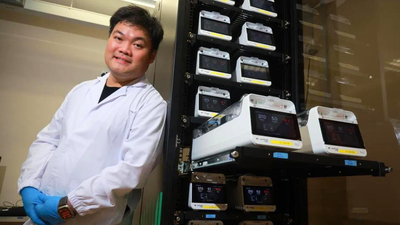
Singapore has unveiled a world-first biological data centre prototype that brings living human neurons into a server-rack environment, marking an unusual new step in the race to build more efficient and adaptive computing systems. Developed through a partnership between the Yong Loo Lin School of Medicine at the National University of Singapore (NUS Medicine), data-centre operator DayOne and biological computing company Cortical Labs, the prototype consists of 20 CL1 biological computing units. Each CL1 uses a network of lab-grown human neurons integrated with silicon hardware, meaning the 20-unit system is estimated to involve roughly 16 million neurons based on the reported figure of about 800,000 neurons per unit. The system was demonstrated at NUS on August 6 and is being positioned as a potential new approach to AI and computing.
16 million living neurons enter the world of computing
The Biological Data Centre prototype has been established at the NUS Life Sciences Institute as part of an effort to move biological computing from laboratory experiments towards practical computing infrastructure. NUS Medicine is working with Singapore-headquartered DayOne and Melbourne-based Cortical Labs on the project, with each partner bringing a different area of expertise. NUS provides expertise in neurobiology and will oversee the culturing and maintenance of the living cells, while DayOne contributes its experience in data-centre infrastructure and Cortical Labs provides the CL1 biological computing technology. NUS says the 20-unit deployment is the world’s first independently operated biologically integrated server rack. The prototype was showcased on August 6, when more than 80 guests from academia, technology, digital infrastructure and the private sector saw the CL1 and Cortical Cloud systems operating, including demonstrations of microelectrode-array integration and real-time neural network activity. The project represents an attempt to build a new category of computing infrastructure in which biological systems work alongside conventional electronics rather than relying exclusively on silicon processors.
How living neurons are being used to process information
The technology behind the system is fundamentally different from a conventional server, although it still depends heavily on silicon hardware. Cortical Labs grows neurons from human stem cells and places them on a silicon-based platform containing microelectrode arrays. These electrodes can send electrical signals into the neural network and record the electrical activity produced by the cells. The CL1 is connected to Cortical Labs’ biological intelligence operating system, known as biOS, which allows software to interact with the neural network in real time. Information can be presented to the neurons through electrical stimulation, while their responses can then influence a simulated environment or computing task. Cortical Labs provides an API that allows researchers to record neural activity, stimulate the biological network and create real-time closed-loop interactions. This means the system is not simply storing living cells next to a computer. The neurons form an active part of the processing loop, with biological activity being translated into information that the surrounding digital system can use. Cortical Labs says the CL1’s internal life-support system can keep the neural cultures alive for up to six months, creating an unusual computing platform that requires biological maintenance alongside conventional hardware and software support.
From Pong-playing neurons to a 20-unit server rack
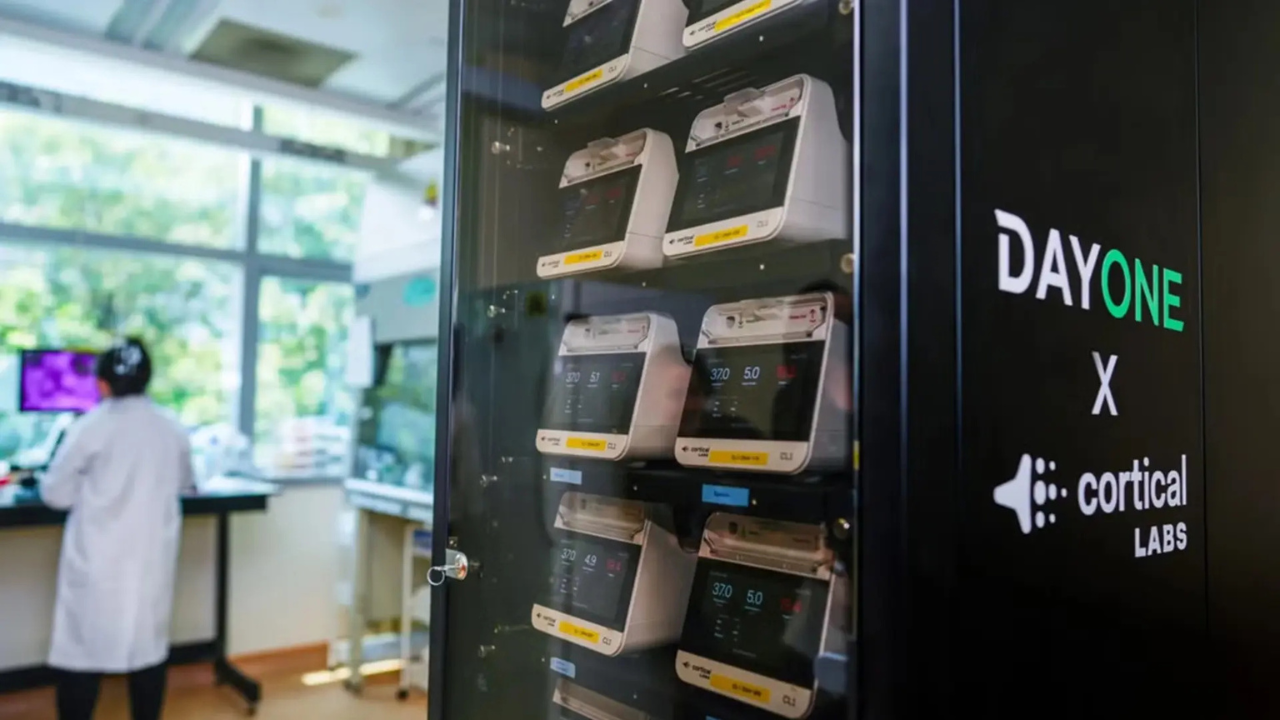
The Singapore project builds on earlier experiments by Cortical Labs that demonstrated how living neural networks could interact with digital environments. The company’s earlier DishBrain system used approximately 800,000 human and mouse neurons connected to a CMOS chip and demonstrated that the cells could learn to play the simple arcade game Pong. In that experiment, electrical stimulation represented information about the game environment, while neural activity was recorded and used to control the paddle. Cortical Labs has described this approach as Synthetic Biological Intelligence, based on the adaptive properties of living neural networks. The CL1 represents a more developed and commercially oriented version of that concept, packaging the biological network, electronics, life-support systems and software into a system that researchers can deploy and program. The Singapore installation takes that idea another step further by connecting 20 CL1 units within a server-rack environment. The often-cited figure of roughly 16 million neurons comes from multiplying the approximately 800,000 neurons associated with an individual CL1 by the 20 units in the rack. However, the total should be described as an estimate because NUS’s announcement confirms the 20-unit configuration but does not independently publish a total neuron count for the rack.
Why biological computing could matter for AI
The researchers believe biological computing could eventually offer advantages in situations where conventional AI systems require large quantities of training data and substantial computing resources. Living neural networks naturally adapt to changing conditions and can learn through interactions with their environment, which is one reason researchers are investigating whether they can complement rather than replace conventional AI systems. NUS says biological computing has the potential to achieve significantly greater efficiency because biological neural systems can operate using a fraction of the power required by digital computers. That possibility is particularly relevant as the electricity demands of AI and data centres continue to grow. The Singapore project is intended to explore applications ranging from drug discovery and biomedical research to advanced AI, energy optimisation, robotics, cybersecurity and fraud detection. Biological computing could also provide researchers with a platform for studying learning and adaptation at a biological level, potentially helping with neurological research and the development of new medicines. Cortical Labs has argued that biological systems could be particularly useful for problems involving limited data because they may learn from less information and adapt as conditions change. However, these advantages remain an area of investigation. The Singapore prototype has not yet demonstrated that biological computers can replace GPUs or outperform conventional AI infrastructure on mainstream workloads, so claims about a major reduction in computing energy use should currently be viewed as potential rather than a proven large-scale result.
Singapore’s experiment could shape the next generation of computing
The significance of the project lies in its attempt to take biological computing beyond individual laboratory demonstrations and place it within an environment resembling real computing infrastructure. NUS and its partners are working towards a larger Biological Data Centre in Singapore, which they describe as the first major facility of its kind outside Australia. An earlier NUS announcement said the initial validation phase was intended to transition towards a live deployment environment within a DayOne commercial data-centre facility in Singapore, with the initial deployment comprising a single rack of 20 Cortical Cloud units. The latest deployment at NUS provides a practical setting in which researchers can investigate how living neural networks can be cultured, maintained, connected to digital systems and used for computing tasks. It also highlights the challenges that biological computing must overcome before it can become a mainstream alternative to conventional servers. Unlike silicon processors, the computing elements are living cells that need controlled conditions and ongoing biological care, and their reported lifespan is measured in months rather than the years expected from conventional server hardware. For now, the Singapore installation should therefore be seen as an important proof of concept rather than the beginning of a wholesale replacement of silicon data centres. Its real importance may be that it establishes a physical platform for testing whether living neural networks can become a practical component of future AI infrastructure.