[ad_1]
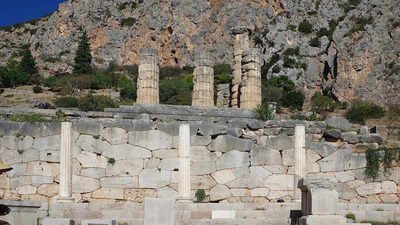
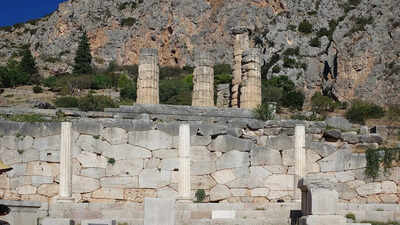
Delphi’s Temple of Apollo, for many centuries, has served as the greatest representation of ancient Greek spiritualism. Located on the steep slopes of Mount Parnassus, this place was the residence of the Pythia, a priestess who used to give out prophesies, which could make or break the future of monarchs and wars. This site, for tourists, is famous for its magnificent marble structures and panoramic views. However, according to recent scientific findings, what seems to be more crucial than the above-ground architecture at Delphi is the highly unstable geological composition underneath.The story of the oracle can be split into two sides historically. For the ancients, it was an ancient truth in which the gods communicated through a medium in a human body. For later doubters, it was often ridiculed as a piece of political showmanship or a mere religious ceremony that had nothing to do with science. But the uncovering of an extensive network of interlinking fault lines underneath the temple has brought about a whole new perspective. It seems that rather than being simply a landscape on which religion occurred, the geography and geology of Greece could have played a part in it.The fault lines of prophecyThe mystery behind what took place within the sacred chamber of the temple came back under scrutiny with the publication of research conducted in the Journal of the Geological Society. It was found that the sanctuary was constructed right at the point where two large fault lines cross each other: The Delphi and the Kernia fault lines. The purposeful positioning of such a structure here was probably deliberate. The cracks in the Earth’s crust facilitated the flow of water and gas to the surface.In the study titled Scent of a myth: Tectonics, geochemistry and geomythology at Delphi, researchers suggested that the friction in this area would be capable of heating up the limestone underneath. This would cause an emission of light hydrocarbons, such as ethylene, whose scent has been found to be sweet and capable of producing a trance-like effect when breathed inside a closed space. This discovery became the surprising physical equivalent of what many ancient authors, like Plutarch, recorded as a “sweet-smelling pneuma” coming out of a fissure in the temple floor.
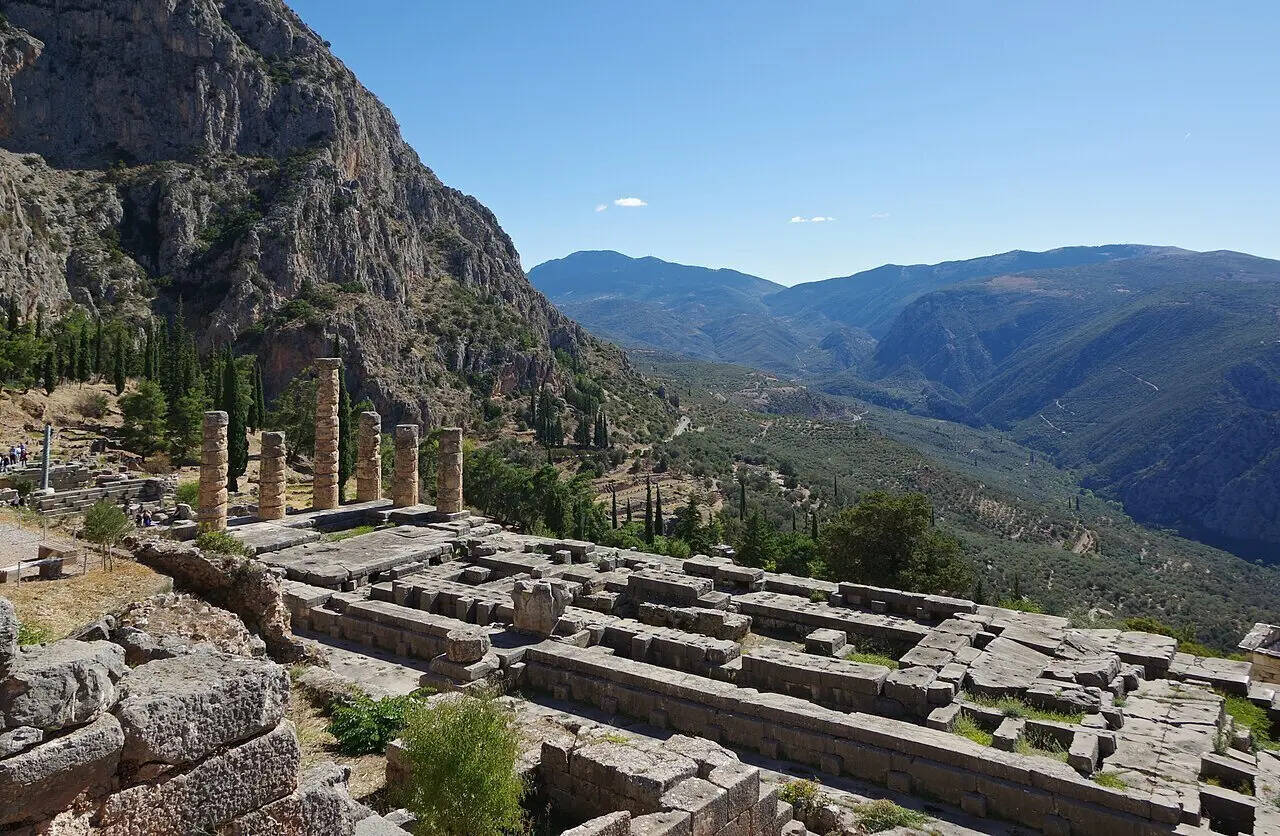
This fusion of earth science and ancient belief highlights how natural phenomena shaped profound spiritual experiences, making Delphi a place where geology and faith intertwined. Image Credits: Wikimedia Commons
In other words, this geological approach doesn’t necessarily “debunk” the importance of the site from the religious point of view. On the contrary, it means that the ancient Greeks had extremely good knowledge of their surroundings and could realise that there was something special about the location. In particular, there was the presence of the physical factors, vapours and the environment, which could then be combined with the religious interpretation.Myth and geology: A dynamic relationshipThere are logical reasons why the “gas theory” is so attractive to people. Archaeologists who studied the place during the early excavations of the 20th century did not discover any trace of the supposed chasm in Delphi, thus leading to a long period of time when the “vapours” became known as a mythical phenomenon. But thanks to advances in modern geochemistry, it became clear that the release of gases can occur at certain times in connection with tectonic activity or groundwater change, even if such occurrences are sporadic.This overlap between earth science and history serves as a great demonstration of how an environmental setting influences human cultures. If the effects on the Pythia were caused by ethylene or some other hydrocarbons, then it would be another confirmation of the physical causes behind the famous state of frenzy of the prophetess. While the temple above provided the setting, the geology beneath Delphi created the energy source for the phenomenon. It means that Delphi was a chosen place where natural phenomena could be transformed into a message for people.While scholars are still debating the issue, the new evidence makes Delphi more real than ever. It is no longer simply a pile of ruins and myths; it is a living setting that allows for testing ideas. As for the fault lines, it is possible to understand why there were so many earthquakes in Delphi in the past. The ancients used to associate such natural events with the presence of divine forces; therefore, the entire landscape becomes part of the process.This is why the appeal of the Oracle of Delphi will never fade; it cannot be reduced to one single thing. The Oracle of Delphi stands on the intersection of tectonics and faith, revealing to us once again that the most intriguing mysteries are not always an “either-or” phenomenon. It did not matter if the Pythia was truly listening to the voice of Apollo or if her words were affected by the limestone’s chemistry; in any case, something very profound happened that left its mark on Western civilisation forever.
[ad_2]
Source link