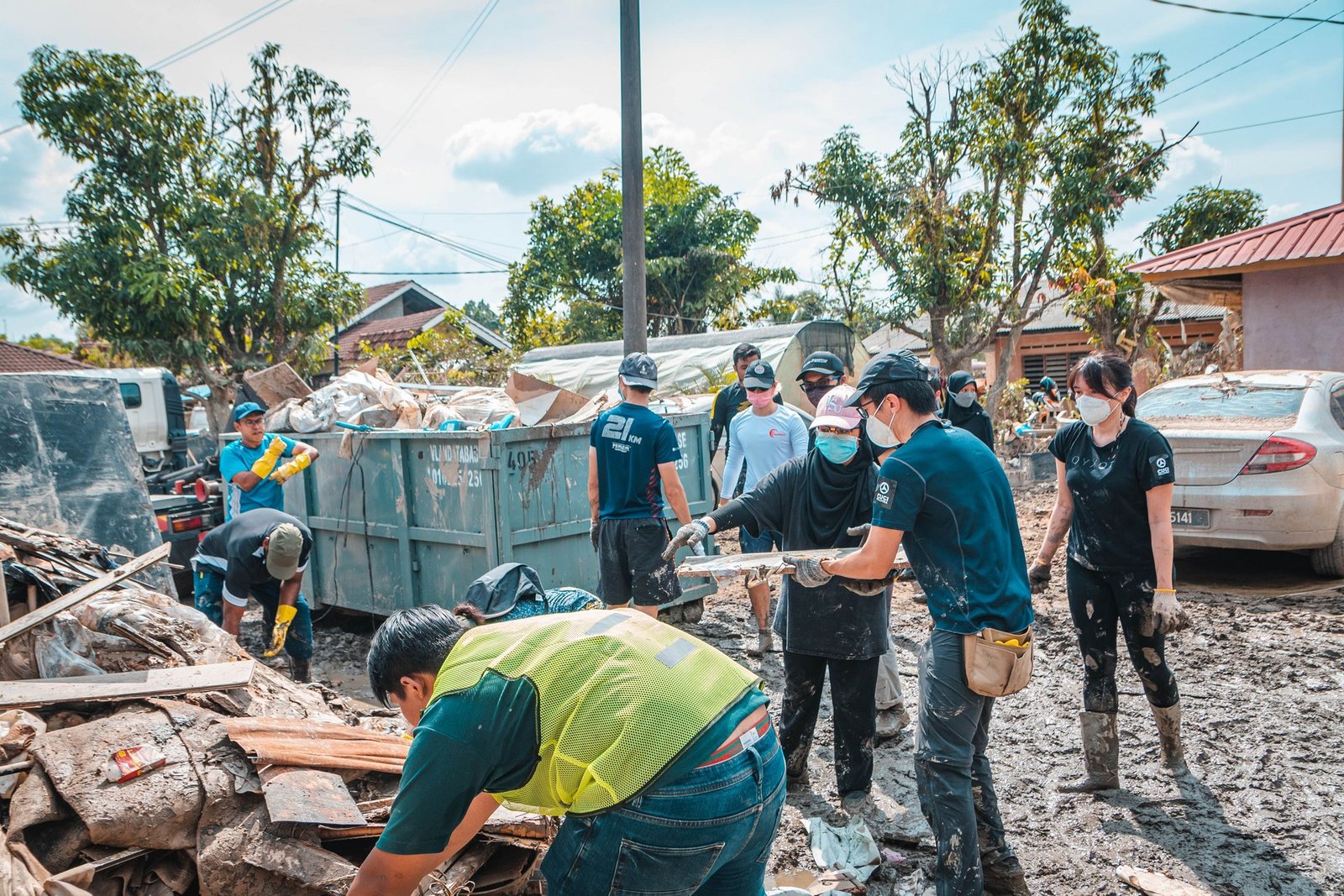
In Borneo, the sky is heavy with a thick, amber-hued haze, a result not of impending rain but of smoke that has spread far beyond Indonesia. This smog has reached as far as Singapore, Manila, and Kuala Lumpur. On the ground, the air is filled with smoke emanating from the soil, likened to tear gas by Dwi Sujatmoko, a 35-year-old volunteer firefighter. “It hits your nose straight away, your eyes burn – that’s more or less what it’s like,” he explains. For over a month, Sujatmoko and many others have been engulfed in this toxic atmosphere, battling fires that appear impossible to extinguish.
Equipped with basic tools, carts, and portable fire pumps, these volunteers, many of whom are indigenous Dayak or Banjar people, are confronting a blaze that has consumed approximately 200,000 hectares of forest and farmland since July. The fires are not just on the surface; underground peat fires continue to smolder, releasing noxious fumes into the air. “Once a fire becomes uncontrolled, it harms many people and the environment,” Sujatmoko states. “If underground fire spreads and can no longer be controlled, the losses are enormous.”
The Threat of Peatland Fires
Indonesia is currently grappling with a wildfire crisis exacerbated by a “Super El Niño,” which has intensified drought conditions. Thousands of fire hotspots have emerged across the nation, creating a haze crisis that has become the worst in over a decade. The fires in Borneo are particularly alarming as they are burning through one of the largest tropical peatland ecosystems in the world. These peatlands, under normal circumstances, act as significant carbon reservoirs. However, when they catch fire, they release substantial amounts of carbon dioxide, carbon monoxide, and methane into the atmosphere.
Dr. Nisa Novita, a peatland researcher at the Indonesian conservation NGO Yayasan Konservasi Alam Nusantara, explains that peatlands are effective carbon stores due to their waterlogged conditions, which slow decomposition and allow carbon to accumulate for thousands of years. However, when these peatlands are drained or burned, they can quickly release this stored carbon, earning the nickname “carbon bomb.” In Kalimantan, peat deposits can exceed 20 meters in depth, harboring more than 6,000 tonnes of carbon per hectare – equivalent to the annual CO₂ emissions of 4,800 cars.
Health Impacts of the Haze
The emissions from these fires have affected thousands across Southeast Asia, causing air pollution indices to soar to unhealthy levels – sometimes 75 times above the World Health Organization’s recommended limits. This has led to a surge in hospital admissions. Indonesia’s Health Ministry reported over 50,000 cases of respiratory infections linked to the fires between July and August, with over 12,000 cases involving children under five.
Susan Page, a professor at the University of Leicester, notes that people living under this pollution cloud are inhaling toxic substances, including carbon monoxide and fine particulate matter, which can cause health issues such as heart problems. The situation is dire at the fire front, where volunteers are risking their lives to put out the fires. Recently, two volunteers in Central Kalimantan died after their health deteriorated from firefighting efforts.
Challenges in Fighting the Fires
Volunteers face numerous challenges, including toxic haze and the exhaustion of constant firefighting efforts. They have been digging ponds, canals, and borewells through dry peat and creating makeshift irrigation systems to combat underground fires. Some volunteers are sleeping close to the frontline to continue battling the blazes at night.
Fahrin Ramadhianto, a volunteer firefighter in South Kalimantan, describes the smoke’s smell as that of decaying wood being burned, characteristic of peat. “The worst thing here has been the smoke,” he says, noting that peat contains decomposed wood and organic material from various sources.
Root Causes of the Crisis
Indonesia’s peatland fires have historical roots in land-use changes dating back to the Suharto era, where land was cleared for logging, plantations, and development projects. Authorities have often avoided blaming industrial actors for the fires, instead pointing fingers at indigenous communities for traditional farming practices that involve controlled burns.
Tono, a representative of the Dayak Kanayatn people, emphasizes that they follow careful planning and customs while clearing land. However, the natural balance is rapidly deteriorating in Kalimantan, which lost nearly 160,000 hectares of forest in 2025, primarily due to plantations and monocrop agriculture. This industrial-scale development has drained peat swamps, making them more susceptible to fires.
As the fires continue to rage, Sujatmoko and his fellow volunteers face ongoing challenges, including water shortages and fatigue. Fighting peat fires requires saturating the ground so thoroughly that it becomes “like porridge,” yet there is a high chance the fire will reignite, fueled by hidden underground sources. Despite the exhaustion and longing for their families, volunteers remain committed to combating the haze disaster, hoping for rain to aid their efforts.