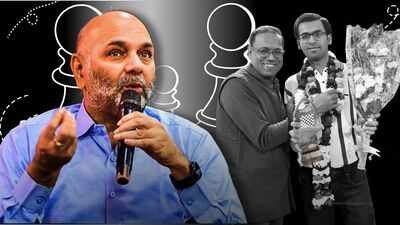
NEW DELHI: In 1978, the chess world was a reflection of a fiercely guarded aristocracy, it can be said. The title of Grandmaster (GM) was not merely a designation. Rather, it was an exclusive fraternity reserved for the absolute statistical anomalies of the human race.To understand what has happened to the modern chess ecosystem, one must first understand what a Grandmaster used to be. To many historians, the very definition of chess mastery has been fundamentally altered.“A Grandmaster result has been a performance equivalent to a 2600 rating. In 1978, there were only six players above 2600. And in 1981, I think there were about twelve or thirteen. So a 2600 performance essentially boiled down to doing as well as the top six or seven or ten players in the world,” India’s veteran Grandmaster Pravin Thipsay told TimesofIndia.com during an exclusive interaction.The rating inflation over the ensuing decades has been astronomical. Thipsay believes a 2600 rating in the early 1980s was the equivalent of a 2750 rating today, a tier reserved exclusively for the absolute best in the business today.Yet, the threshold to earn the GM title remains anchored to the 2600 performance. “Which means the International Master (IM) norm in the 1980s or in the ’70s was more difficult than today’s Grandmaster title,” Thipsay added with a smile.Many feel it has not been an organic evolution of the sport but a deliberate, commercial policy choice.Between 1914 and 1997, the world produced fewer than 300 Grandmasters. But in 1998, under the leadership of then-FIDE President Kirsan Ilyumzhinov, the governing body prioritised global expansion. The criteria for titles were relaxed, and the rating floor, once a jaw-dropping mark of 2200, was eventually plummeted to 1000 (before settling at 1400 more recently in 2024).
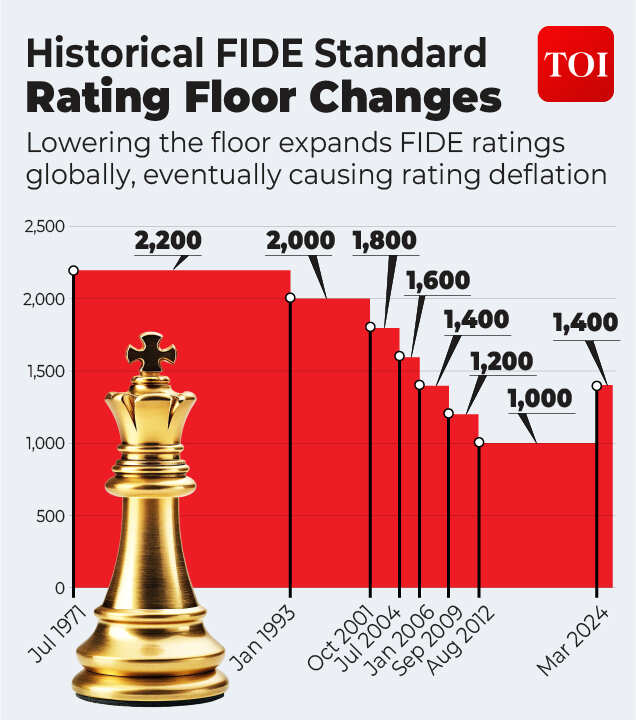
(Graphic by Mukesh Sharma)
By 2004, the world had 1,000 Grandmasters. Today, there are over 2,500.“FIDE started collecting fees for rated players,” Thipsay noted, outlining the financial incentive behind the dilution. “It became an important way of getting money for FIDE during Kirsan’s time. He specifically made it clear in the Congress in 1998 and 2000 that we want to lower down the title, we want to lower down the rating. He said, ‘We want to make everything easy for you so that you can find sponsors more easily.‘”
The Indian explosion
Against this backdrop of global title inflation, India stands on the precipice of a historic milestone.In a matter of weeks, if not days, the nation will crown its 100th Grandmaster. It is a sumptuous achievement for a country that waited until 1988 for Viswanathan Anand to become its first.Today, India is an undeniable superpower as it keeps on churning out prodigies who casually dismantle the world’s elite.But beneath the glittering surface of this golden generation lies a complex, often unspoken reality.
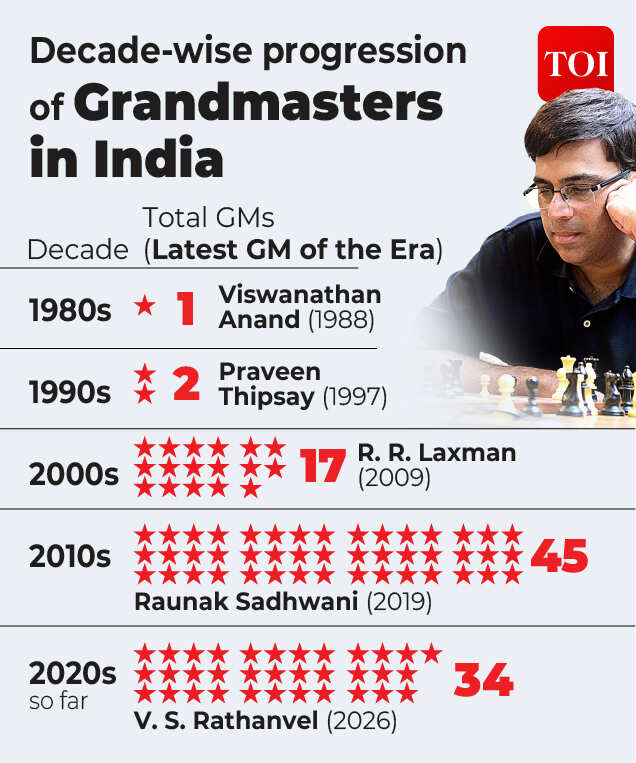
Decade-wise progression of Grandmasters in India (Graphic by Mukesh Sharma/TimesofIndia.com)
As FIDE titles and ratings became vastly more accessible, the grassroots culture of the sport underwent a radical, heavily commercialised shift. The gritty, egalitarian days of the game have gradually evaporated, replaced by an ecosystem catered strictly to the affluent.“There were tournaments where everybody played, everybody stayed in a dormitory, and 80%, 90% of the money collected would go for the prize money,” Thipsay recalled. “Organisers like YMCA provided halls and dormitory accommodation free, and people didn’t really bother. I remember 40, 50 people staying together for my National Juniors, and nobody really grumbled about it.”Today, things are different. One-day rapid tournaments routinely charge entry fees of Rs 2,500 to Rs 5,000. Organisers rake in lakhs, while prize funds remain disproportionately small.“By keeping such high entry fee, you have actually ended up making it a sport for rich people,” Thipsay argued. “A common man, a child of a clerk or a laborer is not able to play even a one-day tournament irrespective of the prize. The entire chess-playing crowd has become the elite class who can afford such luxurious tournaments.”
The “complacency in mediocrity”
Because FIDE ratings are now easily obtained, a dangerous phenomenon has taken root in Indian society. It is what Thipsay terms “complacency in mediocrity”.Getting a rating today is, in his words, “probably one of the easiest things”, achievable by a child after just a year of play. Yet, parents treat it as a monumental triumph.Drunk on early, low-level success, families make drastic life decisions. “Parents think, and the players think that they are good players; they are going to become Grandmasters very soon,” Thipsay said.“Grandmaster is everybody’s ambition, whereas I think the title has not been lowered down to that level that everybody can become Grandmaster. Needless to say, there are many players who give up their studies and try their best in playing, and they end up remaining at the rating level of 1500 to 1700. Most of the players who played chess for thousands of hours, not going to school, remain between 1500 to 1800 level. And now they already have a bad academic record.“With limited professional options outside the sport, these stalled players pivot to the only available avenue, which is coaching.This massive supply of trainers has birthed a sprawling, unregulated industry. Parents are liquidating assets and funnelling lakhs of rupees into private coaching, convinced it is the only path to the GM title.“A need for coaching does not exist, but it is created,” Thipsay, a renowned coach himself, remarked. “The way the coaching takes place is basically spoon-feeding rather than teaching chess.”
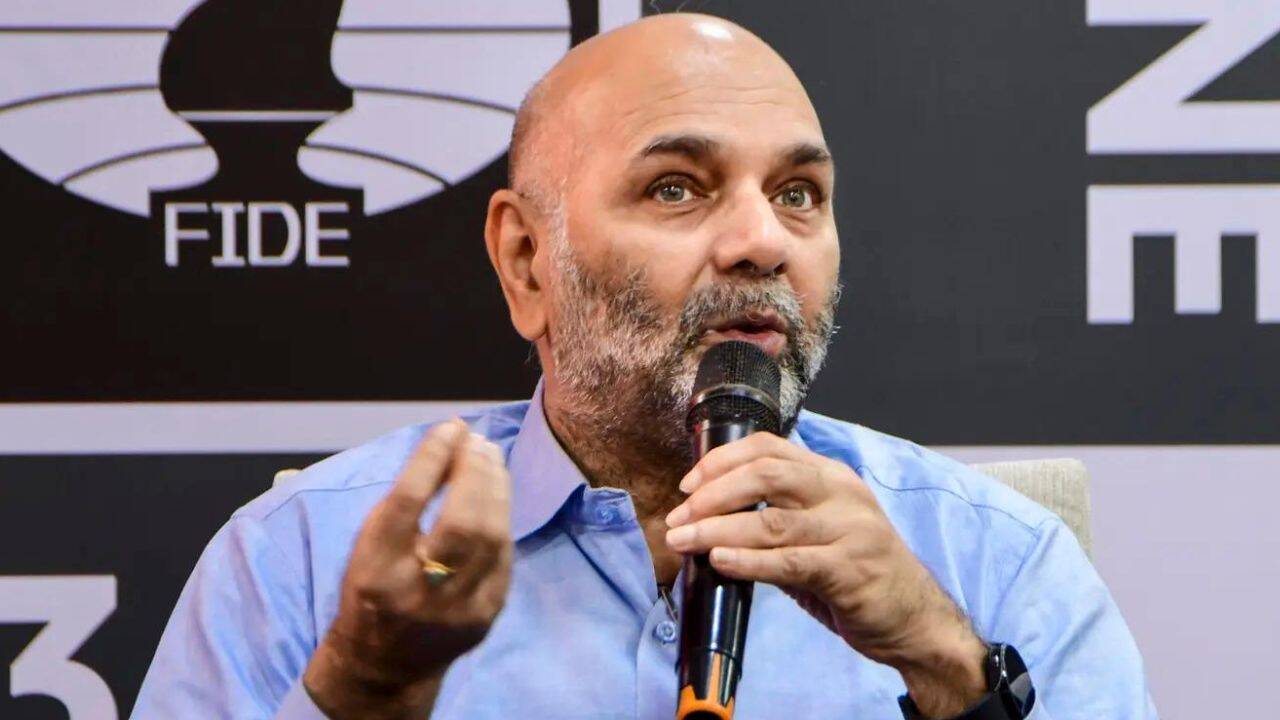
Pravin Thipsay (PTI Photo)
The doctrines of the legends like Dr Emanuel Lasker and Garry Kasparov, who preached that chess cannot merely be taught, tell us that the sole duty of a coach is to cultivate independent thinking.“If you see, out of one lakh players, only three or four are able to think independently,” Thipsay told this website. “We often have to de-train students for two to three years. An untrained child is much easier to teach than a trained child who is often on a wrong track.”Further stressing the notion of independent thinking, he added, “It’s very easy to become a Grandmaster if there is group discussion, if players come together, meet and discuss among themselves. All they need is the process of independent thinking. We need a coach who coaches, say, for 10 hours and teaches them to think independently.“You will not have everybody becoming a Grandmaster. But many of the International Masters in the country would probably have become Grandmasters even without coaching, if they had decided to sit down together and analyse. Many of them may already be doing that as well.”
It’s very easy to become a Grandmaster if there is group discussion, if players come together, meet and discuss among themselves.
GM Pravin Thipsay
Nevertheless, the ongoing chess boom has perpetuated the general idea that an aspiring player must spend a heavy amount on elite coaching to reach the pinnacle.“It’s only a myth, and it’s created to promote the coaches,” Thipsay said, pointing out that players like R Praggnanandhaa, D Gukesh, and Aravindh Chithambaram became top-level Grandmasters without spending exorbitant sums on coaching early on.Furthermore, the financial return on investment is bleak.The veteran GM revealed, “The average income of an Indian Grandmaster through winnings in chess tournaments is less than one and a half lakhs per year. It’s something I would call an unfortunate racket rather than expensive coaching.”
The pure talent argument
Is Thipsay right? Is the modern coaching industrial complex entirely a racket?Grandmaster Aravindh Chithambaram, a multiple-time National Champion known for his immense natural talent and humble beginnings, pushes back slightly on the idea that exorbitant wealth is a prerequisite, but he acknowledges the steep climb.“Not necessarily I feel like one can become a Grandmaster only if he spends 20 lakhs or 30 lakhs,” Aravindh told TimesofIndia.com.
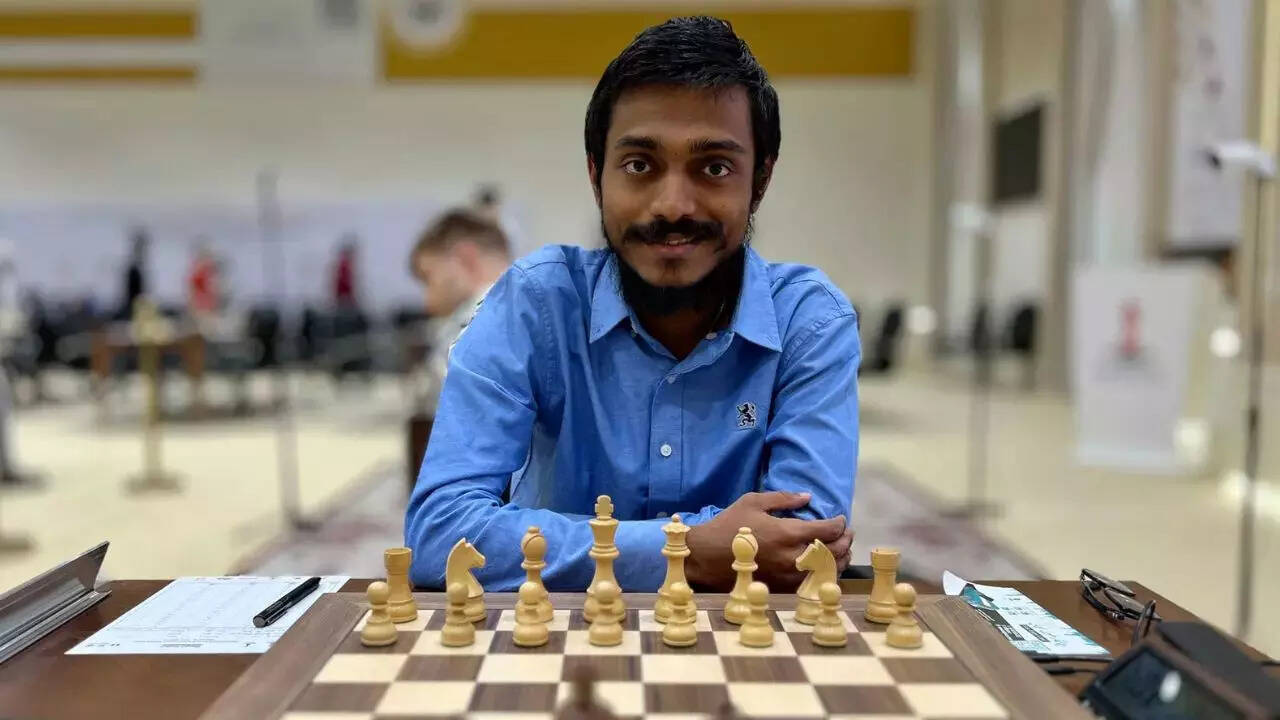
Aravindh Chithambaram. (Special Arrangements)
“I think if a person is really skillful, he can achieve no matter what. But of course, the initial stages would be very hard. Because if you’re not a Grandmaster or even an International Master, of course you will have to spend a lot of money. But once you make the first step, I think the rest of them would be easier comparatively. The first step would be very hard, I would say. But once you understand that you are skillful, you have the talent playing, then things are much easier.“For players of Aravindh’s calibre, raw skill eventually attracts sponsors, mitigating the financial burden.But for those who don’t possess generation-defining talent, the necessity of a coach is less about “spoon-feeding” and more about an invaluable, finite resource like time.
The pragmatic truth of the “Engine Era”
Delhi’s Aaryan Varshney, who recently became India’s 92nd Grandmaster, offers a compelling counterweight to Thipsay’s purist philosophy.Varshney’s journey is highly unusual. He reached the GM title at 21 without a formal academy, expensive foreign trainers, or a titled coach.
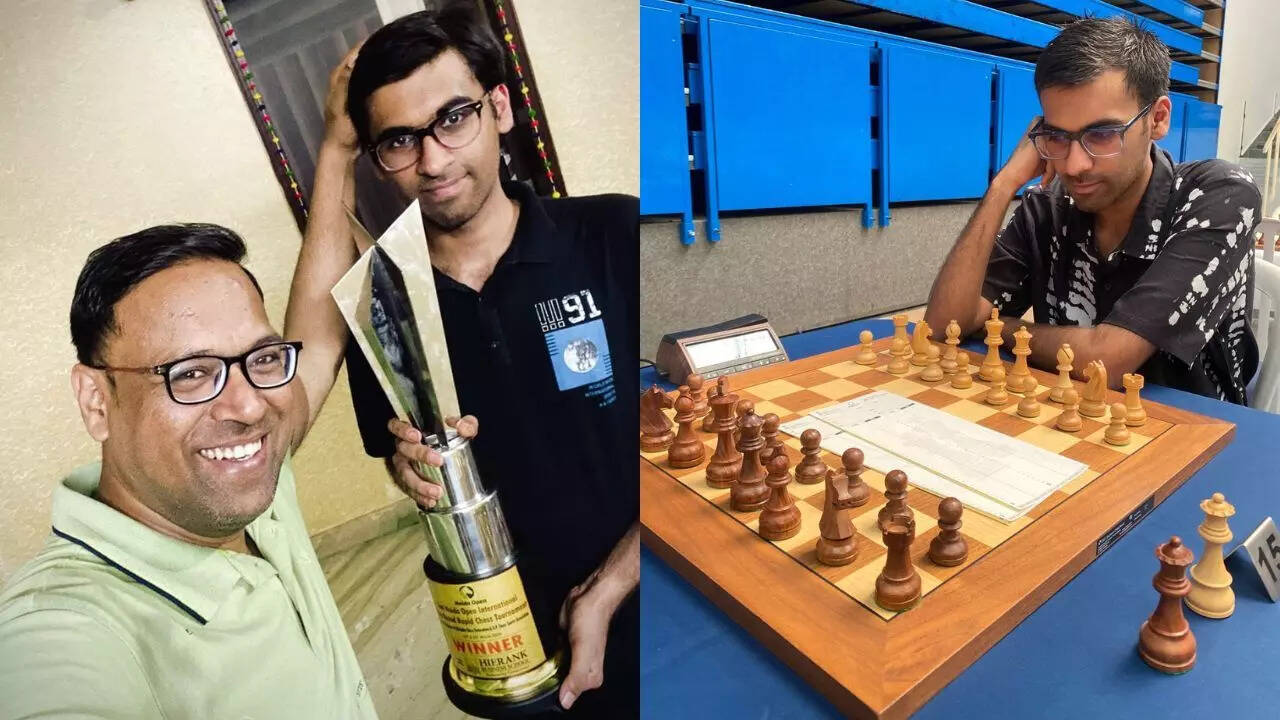
Aaryan Varshney’s father a guiding force for his son (Special Arrangements)
Instead, he was guided entirely by his father, Gaurav, a single parent who left his job to study the game alongside his son. Yet, despite his DIY success story, Varshney is adamant that going it completely alone in the modern era is a mistake.“If someone really wants to become GM, then they have to have someone who can sit with them and analyse games, sometimes all night, like my father did,” Varshney told this website.“A coach wouldn’t necessarily do as much as my father did. But you need someone, at the very least. You can’t do everything completely on your own. I didn’t do anything. I’m telling you from my own experience. My father did the whole thing for me. So, doing everything yourself makes the journey difficult. You need a coach.”
If you’re doing something yourself, something that might take us five hours, a coach can get you to do it in one hour.
GM Aaryan Varshney
To Varshney, the value of a coach is not in inflating a player’s ego, but in condensing the gruelling hours of modern computer engine analysis.“It’s not necessary for your coach to be an IM or a GM. The important thing is that the coach should be good, someone who can actually teach the child,” Varshney pointed out. “If you’re doing something yourself, something that might take us five hours, a coach can get you to do it in one hour. Would you rather spend five hours or one hour? Obviously, everyone would prefer one hour.”Varshney’s reality check underlines the modern burden placed on young players.“Even analysing games yourself becomes difficult, because when you look at the engine, you can get stuck trying to understand why a particular move is good,” Varshney explained. “Someone who already has that knowledge can explain it to you easily. Whatever I was struggling to understand, my father would explain it to me in two minutes. Otherwise, I would just sit there trying to figure it out.”As India approaches its 100th Grandmaster, the ecosystem supporting these players remains a paradox.Thipsay is undeniably right. The title is statistically easier to obtain than it was in 1978, and the fear-mongering that demands parents spend lakhs on coaching is, in many cases, a predatory racket preying on affluent families.Yet, Varshney’s lived experience proves that in the modern computer era, navigating the labyrinth of chess theory without a guide is a punishing task.Also Read: Gave up IIT, left home, slept on roads: How Rajasthan’s first AGM put Udaipur on global chess mapA player does not need an exorbitant, six-figure coaching setup to become a Grandmaster. But they do need a translator for the digital age.India will soon celebrate its 100th Grandmaster. But behind the celebratory headlines, the true challenge will remain as to how the ecosystem ensures the sport remains a battle of minds, rather than a battle of bank accounts.