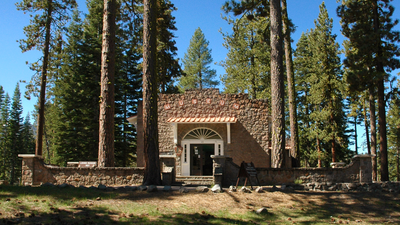
In 1929, local homesteader and photographer Benjamin Loomis and his wife, Estella, formally gave 40 acres of valuable mountain land to the United States government. The donation included a hand-built museum and a working seismograph station beside Manzanita Lake. The deal was the first known case in American history of a privately built museum being donated directly to a US national park. In return for the land and its educational buildings, the couple kept a small lifetime lease on a plot across the road, where they built a home and photo gallery to support themselves in retirement. Today, the building is known as the Loomis Museum at the north-west entrance of Lassen Volcanic National Park. It remains a lasting example of public-minded giving and the early study of volcanoes in Northern California.
Recording the return of Lassen Peak
The museum’s story began in May 1914, when Lassen Peak suddenly became active again. A series of steam explosions and volcanic eruptions continued through 1915. Benjamin Loomis, a local merchant, lumberman and self-taught photographer who had lived near Manzanita Lake since he was young, quickly headed towards the volcano. He carried a heavy view camera and glass-plate negatives to record the activity. His photographs of huge ash plumes on 14 June 1914, along with images of large mudflows and glowing rocks falling from the volcano, attracted attention across the United States. The photographs were distributed by national newspapers and displayed around the country. Loomis’s detailed record helped build public support for protecting the area. That support contributed to President Woodrow Wilson signing legislation that created Lassen Volcanic National Park in 1916. After the death of their only child, Louisa Mae, in 1921, the couple decided to honour her memory by creating a public centre devoted to science and the history of the volcano. In 1926, the Loomises bought 40 acres at Manzanita Lake. By 1927, they had built the Louisa Mae Loomis Memorial Museum using local volcanic stone, timber and reinforced concrete. The building included Italian Renaissance-style features adapted to withstand heavy mountain snow. It was designed to display Loomis’s historic glass-plate photographs, rock collection and educational exhibits about the geology of the Cascade Range.
Early earthquake monitoring
Beside the museum, Benjamin Loomis also built a small reinforced concrete seismograph hut. Working with geologists from the University of California, Berkeley, and the United States Geological Survey (USGS), Loomis installed a heavy Wiechert seismograph inside the building. It was used to record earthquakes and monitor underground activity around Lassen Peak. The station was among the earliest continuous earthquake monitoring sites in the Cascade Volcanic Arc. It provided important information about activity beneath the volcano long before today’s automated monitoring networks were available. Although the couple operated the facility privately, they understood that its long-term protection would require federal management. In 1929, they formally transferred the entire 40-acre property, including the museum and seismograph station, to the National Park Service.According to historical records maintained by the National Park Service, the donation created an early example of cooperation between private citizens and the federal park system. It also gave the National Park Service a fully equipped visitor centre built and funded by private donors. After transferring the land, the Loomises built a small home and photo studio on their leased plot across from the museum. They continued living there and sold postcards, photographic film and books to visitors until Benjamin died in 1935.
Protecting the historic museum
The museum’s survival was not always guaranteed. During the National Park Service’s “Mission 66” modernisation programme in the 1950s, officials considered demolishing the building. Historic records show that some planners criticised its design as “ugly quasi-Spanish.” Local preservationists and historians, however, argued that the building was an important part of Lassen’s history. Their efforts helped change the Park Service’s plans. The Loomis Visitor Center and its seismograph station were officially added to the National Register of Historic Places on 25 February 1975. The National Park Service later carried out major restoration work in 1994 and 1995. The projects repaired the original stone exterior, strengthened the seismograph hut and updated the museum’s exhibition space. In 2006, federal authorities expanded the historic designation to include the wider site as part of the Manzanita Lake Naturalist’s Services Historic District. Today, the Loomis Museum remains open each year from May through October. It displays original photographs from the 1914 eruption, historic seismology equipment and other artefacts that help visitors understand the powerful geological forces that continue to shape Northern California.