[ad_1]
It was 1942, the middle of World War II, and life in the English countryside had not slowed down. There were fields still to be ploughed, there were harvests still to be taken, and Gordon Butcher was out there doing his job in spite of the biting cold and the frost-hardened ground. Then, in the middle of the row, his plough hit something hard.That one jolt changed everything.Butcher had not hit a rock or a buried pipe. It was a hoard of Roman silver, thirty-four pieces in all, and it had lain undisturbed in that Suffolk field for more than a thousand years. The find, known as the Mildenhall Treasure, remains one of the most remarkable Roman archaeological discoveries ever made in Britain.So what exactly did he find?Short answer: a lot. It was not just any old random stuff. It was the finest Roman tableware, the kind of silver that was used for high-status dining in the Roman world, carefully crafted and clearly the property of someone very rich and powerful.Richard Hobbs’s The Mildenhall Treasure, published by the British Museum Press, describes the treasure as a collection of deep significance, catalogued and studied in serious depth. The 28 pieces now held at the museum aren’t just pretty objects; they’re a window into Roman luxury culture, the kind of wealth that extended well beyond Rome itself, to the British Isles. The hoard wasn’t just thrown into the ground randomly. It was deliberately hidden or placed, then simply never retrieved. Whatever the original owner’s plan was, it didn’t survive, but the silver did.
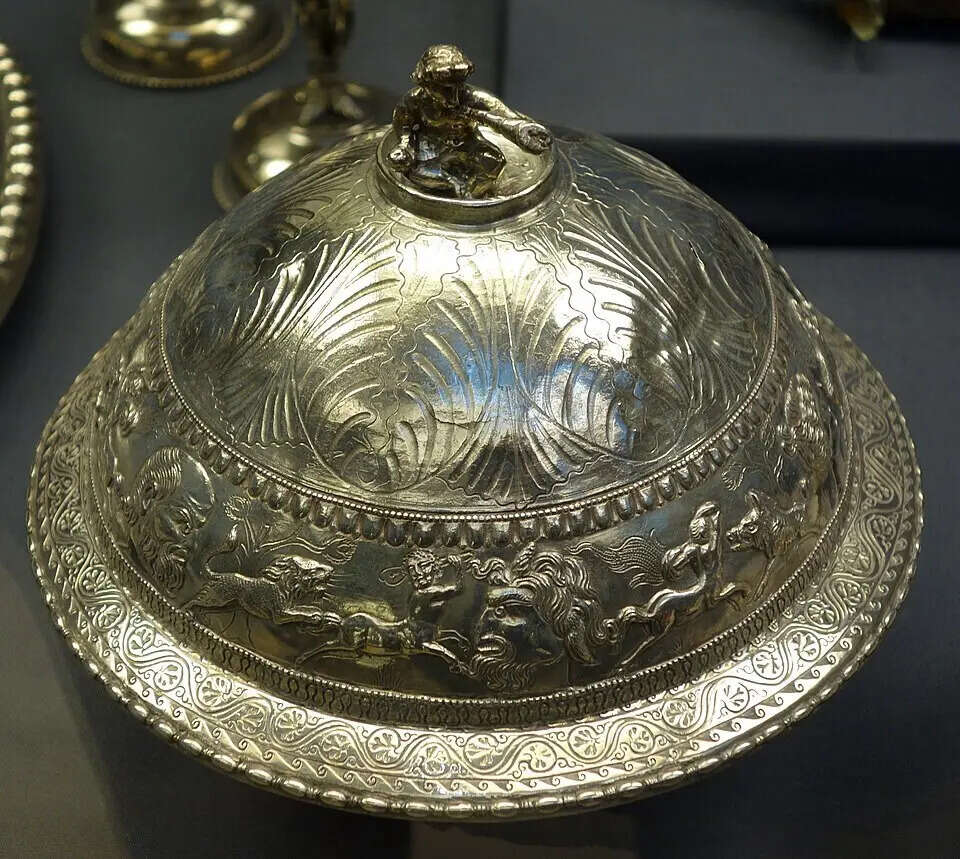
Each item in the Mildenhall Treasure tells its own story of Roman wealth and craftsmanship.Image Credits: Wikimedia Commons
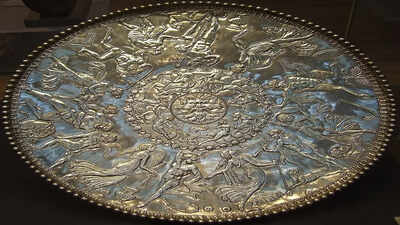
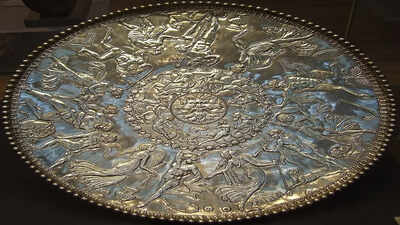
The crown jewel: A dream-sized dinner plateIf you had to choose one thing from the entire collection that makes people stop and stare, it’s the Great Dish. It weighs some 8kg (17 lbs) and is one of the largest and most spectacular discoveries of Roman silver in Britain.Imagine carrying a fully loaded cast-iron skillet through a kitchen. Now make it a 2,000-year-old, elaborately decorated silver piece. Such is the Great Dish for you. It’s not only heavy, but it’s a statement. In the Roman world, such a vessel would have been the centrepiece of an extravagant dinner, a sign of status, power and serious taste. The hoard is one of the finest collections of Roman silver found in Britain, according to The Guardian, with the Great Dish the undisputed centrepiece of the collection.From Suffolk farm to one of the world’s great museumsButcher found the pieces, and the treasure was eventually sold, but not before a complicated history involving a man named Sydney Ford, Butcher’s boss. There was much debate about how the find was handled, and the chain of custody in those early years was messy, but the Mildenhall Treasure ended up in the British Museum, where it has been studied, displayed and marvelled at ever since. The items had a new life, from farm dirt to museum glass, from buried relics to cultural landmarks and archaeological evidence.Why this story still resonatesThere is something cinematic about the Mildenhall Treasure that continues to fire people’s imaginations decades later. It has it all: a wartime setting, an everyman, a dramatic accidental discovery, jaw-droppingly fabulous workmanship.However, the find is important for our understanding of Roman Britain, far more than just the drama. This elite silver shows that Roman luxury culture was not restricted to Italy or the great imperial cities. It reached as far as a quiet field in Suffolk. That frozen field testified to Britain’s link to a much wider world of wealth, trade and prestige.Sometimes history doesn’t wait for the right person to appear. Sometimes it just sits there in the dirt, waiting for a regular workday to go wrong.
[ad_2]
Source link