[ad_1]
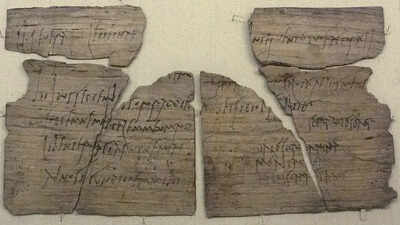
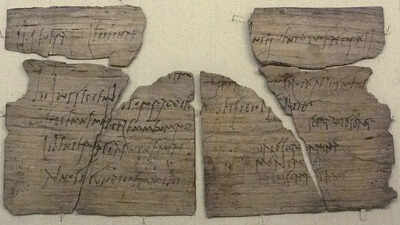
Imagine yourself as an archaeologist digging through thick, black mud at a Roman fort in northern England, and you find what looks exactly like a handful of wet wood shavings. Most people would just throw them away, but the excavator working at Vindolanda in 1973 didn’t, and that split-second decision ended up changing everything we thought we knew about life in Roman Britain.From that muddy trench came the Vindolanda Tablets, thin, postcard-sized pieces of wood that were used as writing surfaces nearly 2,000 years ago; and amidst military records and supply lists was something entirely unexpected: a personal note from a Roman woman, Claudia Severa, inviting her friend Sulpicia Lepidina to come celebrate her birthday. Now thought to be the oldest surviving birthday invitation in the world, it dates from around 100 AD. How did any of this survive?Wood isn’t supposed to last two millennia. Usually, it just rots away, but Vindolanda is in a part of Northumberland just south of Hadrian’s Wall, where the ground has a special property: it is waterlogged and oxygen-poor. Archaeologists call this anaerobic, which means that bacteria couldn’t survive there.A 2021 study in Scientific Reports found that the site’s unique chemical and microbial composition, shaped by local geology, water flow and hundreds of years of human activity, created an environment that actively inhibited decomposition. So, in effect, the soil at Vindolanda was not simply passively preserving things; the soil’s chemistry was actually doing the work. Thus, the leather boots and the cloth and the bones and those thin wooden writing tablets all occurred in the same strata of the buried. Now the same preservation system is threatened by climate change, and the tablets recovered so far might be among the last to emerge from that ground intact.
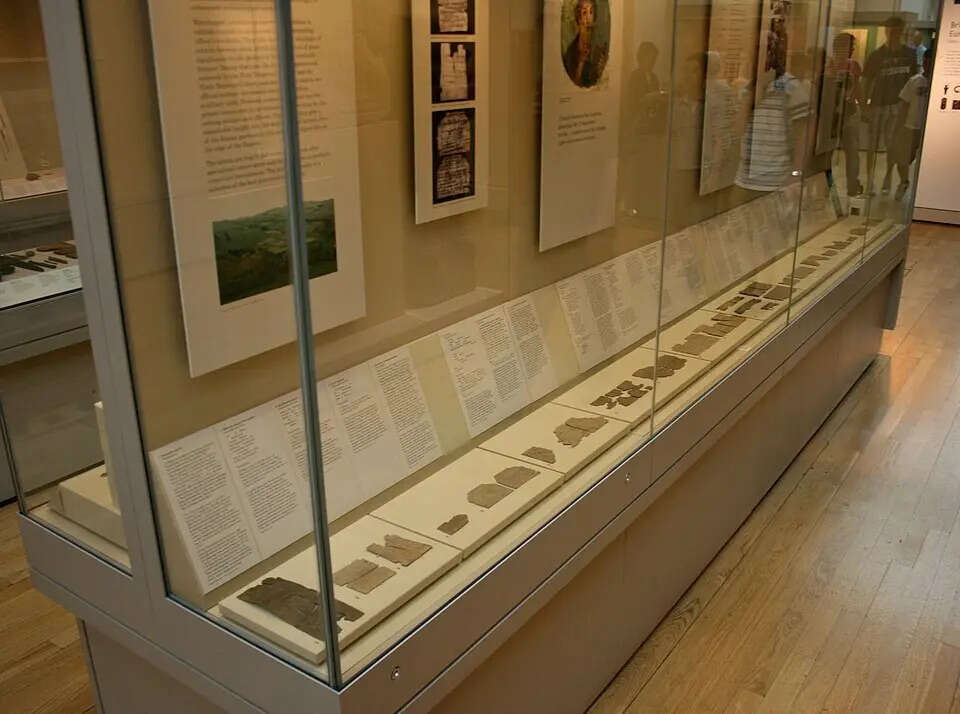
The Vindolanda Tablets on display at the British Museum’s Weston Gallery of Roman Britain.Image Credits: Wikimedia Commons
The birthday noteThe note from Claudia Severa is brief. She writes to her friend, the wife of another Roman officer stationed nearby, inviting her to her birthday party. There is also a postscript, with a slightly different handwriting, thought to be Claudia’s own, added after a scribe had written the formal part of the letter.That little detail is amazing even. Claudia’s letter, known as Tablet 291, is the earliest example of Latin by a woman, according to a 2016 analysis published in the Peitho Journal, and her personal postscript is evidence of women’s literacy at the Roman frontier. This is not a carved monument or an official military record; this is a woman writing something personal to a friend almost two millennia ago.What has changed in our view of Roman BritainUntil this kind of tablet, most of what we knew about Roman Britain came from forts, coins and great inscriptions chiselled in stone. That’s the kind of thing that survives because it’s built to last, but the day-to-day lifestyle? That usually disappears.Vindolanda moved the figures with the shopping lists and requests for more beer and warm socks, complaints about the weather, and that birthday invitation. In the buried layers of the site was a cross-section of Roman daily life: not just the official record, but the human one beneath it.The tablets are now in the British Museum in London, with a set of replicas in the museum at Vindolanda itself. If you ever find yourself in Northern England, you can stand a few feet away from that birthday invite that popped up from the ground.The bigger lesson hereThe Vindolanda tablets are not just a neat archaeological story. They remind us that history is not only made by emperors and generals. It also includes birthdays, friendships, and little moments that are hardly ever written down. Those voices remained buried at Vindolanda for nearly 2,000 years. It took one excavator in 1973 to know that these wood shavings deserved a second look.
[ad_2]
Source link