[ad_1]
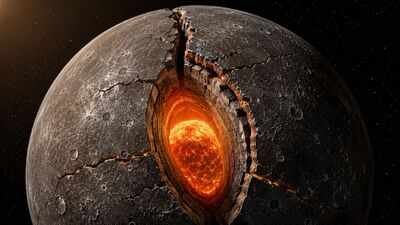
Mercury is the smallest planet in the Solar System, only slightly larger than Earth’s Moon, but what lies beneath its battered surface is anything but small. Its metallic core stretches out to nearly 85 per cent of the planet’s total radius, leaving behind a rocky shell so thin it barely qualifies as a shell at all. Over billions of years, as that core has cooled, the whole planet has contracted, and its brittle crust has had to absorb the strain, buckling into cliffs and ridges hundreds of kilometres long. It is this lopsided internal structure, an enormous core wrapped in a wafer of rock, that explains much of what makes Mercury such an odd world.
How scientists discovered Mercury is still shrinking
Perhaps the more striking part is that this is not something that happened and stopped. Images taken during MESSENGER’s final, lower-altitude orbits turned up small fault scarps far younger than the large ones discovered decades earlier, evidence that Mercury is still shrinking and still tectonically active right now.A study published in Nature Geoscience, titled ‘Widespread small grabens consistent with recent tectonism on Mercury’, researchers catalogued 190 grabens, narrow strips of ground that have dropped down between parallel faults, spread across 48 separate structures on the planet, and estimated many to be roughly 300 million years old or younger, based on how quickly such features would otherwise fill in with impact debris and dust. A notable share of these clustered around the Caloris basin, one of Mercury’s largest and oldest impact scars.
Mercury’s giant core makes up nearly 85 per cent of the planet’s radius
Mercury’s core measures around 1,289 miles (2,074 kilometres) across, according to Nasa, which works out to roughly 85 per cent of the planet’s radius, and there is evidence that portions of it remain partly molten even today. The outer shell surrounding it, the equivalent of Earth’s mantle and crust rolled together, comes in at just 400 kilometres (250 miles) thick. That single fact makes Mercury the second densest planet in the Solar System, beaten only by Earth, simply because so much of its mass is packed into dense metal rather than spread through lighter rock.The planet formed the usual way, roughly 4.5 billion years ago, out of gas and dust pulled together by gravity, settling into the same basic core-mantle-crust arrangement seen on the other rocky planets. But Mercury ended up with so much material sinking into the core that comparatively little was left for the rock above it. That thin outer layer never had much bulk to absorb or soften whatever was happening deep inside the planet, which is really where the story of Mercury’s cracked surface begins.
Mercury’s cooling core is causing the planet to shrink
Once a core that size starts cooling, the shrinkage does not stay hidden. With so little rock standing between the interior and the surface, a contracting core drags the crust down with it, and a brittle shell under that kind of pressure does not bend; it breaks. As per Nasa, this cooling forced Mercury’s crust to fracture and thrust upward along faults, producing scarps up to hundreds of miles long and, in some spots, over a mile high. Mariner 10 caught the first glimpses of these cliffs back in the mid-1970s, and MESSENGER later filled in the details during its 2011 to 2015 mission.What MESSENGER found upended earlier assumptions about just how much the planet had shrunk. Nasa’s Photojournal reports that a mapping effort covering nearly 6,000 ridges and scarps concluded Mercury had contracted up to seven times more than previous, less complete surveys had estimated. It was not a small correction; it was a significant reassessment of the planet’s entire thermal history.
How Mercury’s surface reveals activity deep inside the planet
None of this activity can be observed directly from inside the planet, so scientists are left reading the surface for clues about what is happening below. According to Nasa, Mercury’s magnetic field, sustained for billions of years, together with the gradual cooling of its still-hot outer core, fits with the possibility that the planet experiences its own version of quakes, tremors that seismometers might one day be able to detect and confirm.There is more to learn here. The European Space Agency’s BepiColombo mission is expected to enter orbit around Mercury and deliver sharper images than MESSENGER managed, which should help researchers spot even more of these small, young tectonic features. For a planet built almost entirely around a single oversized core, every new crack in its surface adds another piece to the puzzle of how it has changed since it first came together.
[ad_2]
Source link