[ad_1]
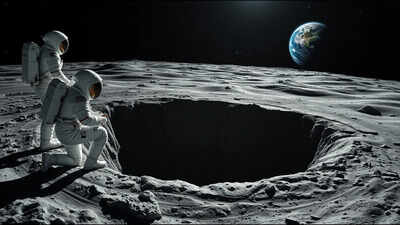
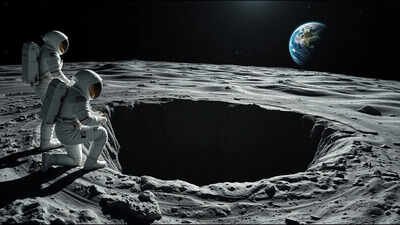
Beneath the permanently shadowed craters near the Moon’s south pole, scientists believe significant deposits of water ice may be buried out of reach of the instruments currently used to search for it from orbit. A new study led by researchers at the University of Maryland, Lawrence Berkeley National Laboratory and the University of Hawaii proposes a different way to find it, listening for the way seismic waves, the same vibrations recorded during earthquakes on Earth, change as they pass through frozen versus dry lunar soil. The findings arrive as NASA prepares to send astronauts toward the Moon’s south polar region through its Artemis program, with crewed landings currently targeted for 2028, and as ice preserved inside these permanently dark craters is increasingly viewed as one of the most valuable resources future lunar missions could use directly rather than hauling in from Earth.
Why finding lunar ice matters so much for future missions
According to the University of Maryland, water ice discovered on the Moon could serve multiple practical purposes at once. Once melted and purified, it could provide drinking water for astronauts, while electricity could split it into oxygen for breathing and hydrogen for rocket fuel, significantly reducing the amount of material that long-duration missions or permanent lunar outposts would otherwise need to carry from Earth. Nicholas Schmerr, an associate professor in UMD’s Department of Geological, Environmental, and Planetary Sciences and a co-author of the study, said identifying any usable lunar materials is essential precisely because astronauts will be limited to the resources they bring with them, making anything they can find and use directly on the Moon valuable, particularly for longer-term missions or outposts.The scale of lunar ice deposits remains genuinely uncertain, largely because of a basic limitation in how scientists currently search for it. Orbiting satellites can survey the Moon’s surface, but their observations are largely confined to the shallowest layer of soil, meaning deposits buried significantly deeper could be going entirely undetected using current remote sensing methods alone.
How seismic waves can reveal ice hidden below the surface
The method rests on a measurable physical difference between dry and frozen lunar soil. According to the study published in Science Advances titled The seismic signature of lunar ice, ice makes surrounding material stiffer, causing seismic vibrations to travel two to three times faster through it than through dry soil, while ice-rich regions can also reflect seismic energy back rather than allowing it to pass through, producing an effect similar to sound echoing off a wall. According to Schmerr, a properly positioned lunar seismometer could pick up both of these signatures at once, meaning scientists could use seismic waves not just to detect whether ice is present, but to estimate roughly how much of it exists in a given area.
How researchers tested the idea using three separate methods
To build confidence in this approach, the research team combined three complementary lines of evidence. According to the University of Maryland, lead author Harrison Lisabeth, a UMD geology graduate and rock physicist at Lawrence Berkeley National Laboratory, began with volcanic rock sourced from Arizona that closely resembles lunar dust once crushed. Lisabeth froze the material and used X-ray imaging to observe exactly how ice formed and collected within the microscopic gaps between individual grains, helping establish how frozen lunar soil is likely structured below the surface.Co-author Matthew Siegler of the University of Hawaii built detailed temperature models of the Moon’s south polar region, identifying which permanently shadowed craters have remained cold enough to preserve ice for billions of years. Schmerr then used these results at UMD to run computer simulations of small moonquakes travelling through and interacting with buried ice deposits. Across all three approaches- laboratory measurements, temperature modelling and seismic simulation- the presence of ice consistently produced clear, measurable changes in the resulting seismic signals, with the team reporting that their integrated model can simulate the Moon’s subsurface to depths of roughly 800 metres.
What buried lunar ice could reveal about the early solar system
Beyond its practical usefulness to future astronauts, lunar ice carries genuine scientific value in its own right. Permanently shadowed polar craters can trap and freeze volatile substances like water, preserving them largely undisturbed for immense stretches of time. Because some lunar rocks are estimated to be roughly four billion years old, ice trapped among them could potentially preserve evidence from the earliest history of the solar system, offering scientists a way to study how water was originally delivered to the inner planets. Schmerr noted that the Moon witnessed some of the most critical parts of the early solar system, including how water was delivered, and said studying that ice could reveal how water spread more broadly and, ultimately, how Earth’s oceans came to form.
When these predictions could actually be tested
Researchers may not have to wait long to see whether their predictions hold up. China’s Chang’e-7 mission is expected to land near Shackleton Crater in late 2026 carrying a seismometer, in a region already home to several suspected ice deposits. NASA’s Artemis astronauts could follow in 2028 by deploying the Lunar Environmental Monitoring Station, a seismic exploration instrument Schmerr helped develop, while the team also plans to apply its new models to NASA’s upcoming Volatiles Investigating Polar Exploration Rover mission, which will use seismic waves generated during drilling to search for ice potentially buried deeper than the rover’s other instruments alone could detect within the surface’s uppermost metre.
Why this remains a prediction rather than a confirmed discovery
The researchers themselves are careful to describe this as a testable hypothesis rather than a confirmed finding. Their model is built on a terrestrial rock simulant rather than genuine lunar polar soil, meaning real material returned from the Moon’s poles could behave somewhat differently once tested directly under identical conditions, something the research team says will require further field validation. As Schmerr put it, no one has yet physically measured ice on the Moon using this method, but the study now offers a specific, testable prediction for what future seismic instruments should look for once they finally reach the lunar surface, a modest but genuinely important first step toward confirming exactly how much water ice the Moon’s shadowed craters are actually hiding.
[ad_2]
Source link