Imagine an ancient amphora recovered from the seabed after centuries underwater. It may be cracked, covered with deposits or missing large sections. Restoring such an object is difficult without causing further damage.To overcome this problem, researchers at Koc University in Turkiye have developed a conservation method that combines photogrammetry, digital modelling, 3D printing and embedded sensors, Phys.org reported. It is designed to replace missing parts of archaeological ceramic objects while also helping conservators monitor changes that could affect their condition.The approach was described in a study published in the Journal of Cultural Heritage. It was developed by archaeologists and engineers from Koc University’s Mustafa V Koc Maritime Archaeology Research Center (KUDAR) and Manufacturing and Automation Research Center (MARC).
3D repairing of pottery
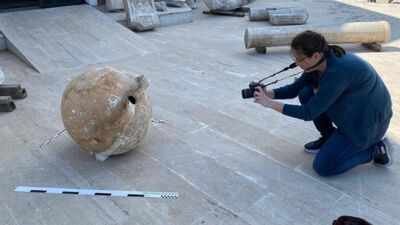
The process begins by photographing the archaeological amphora. Researchers take hundreds of overlapping photographs of the object. These images are then processed using photogrammetry software to create a detailed three-dimensional digital model.Once the model is created, researchers can digitally reconstruct the missing section of the ceramic object. The replacement can then be produced using 3D-printing technology and customised to fit the damaged amphora.The researchers developed what they describe as customised ‘smart’ fills. Sensors can be integrated directly into the 3D-printed replacement section. These sensors are designed to detect changes in temperature, humidity, pH and physical stress.
Sensors track artefacts
Temperature, humidity and physical stress can affect the stability of archaeological objects. The researchers noted that such changes can contribute to salt migration, deformation and microfractures, among other forms of deterioration.The researchers tested the methodology using maritime amphorae from two collections. One group consisted of Günsenin IV amphorae recovered from the late Byzantine Camaltı Burnu I shipwreck. These amphorae are displayed at the Bandırma Archaeology Museum in Turkiye.The second collection consisted of a mixed group of amphorae from the Amalfi coast. These objects are held at the Minori Villa Romana e Antiquarium in Italy.Initial measurements taken in museums showed that the integrated sensors could record daily changes in temperature and humidity. A stress sensor also detected patterns of force affecting the objects.The method could be particularly useful for maritime archaeological objects. Artefacts recovered from underwater environments can experience mechanical, chemical and biological deterioration.The researchers said further work will examine the results, practical applications and cost-effectiveness of the approach.